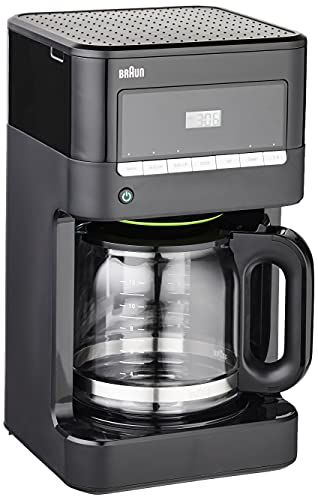
I never thought I’d be standing in my kitchen at 5:45am, stopwatch in hand, timing how quickly the Braun Brew Sense could rescue me from my morning fog. But after my beloved thrift store coffee maker finally died, I needed something reliable without breaking the bank.
Here’s the surprising part: I initially bought this Braun model as a temporary solution while saving for a fancier machine. Three weeks later, I’m no longer window-shopping for upgrades. Let me explain why.
## The Monday Morning Test
Let’s be honest – I’m barely human before coffee. My testing scenario was brutal: half-asleep, fumbling in semi-darkness, desperately needing caffeine before my 7am Zoom calls. The Brew Sense’s programmable timer became my secret weapon. Setting it up the night before meant waking to fresh coffee without the foggy-brained measuring and spilling.
However, I learned this convenience comes at a cost. The machine draws about 1.2W even when idle – not terrible, but it adds up to roughly $4-5 annually. Small price for sanity, perhaps.
The first morning I used it, I made a critical error – I didn’t lock the filter basket properly. The resulting puddle taught me to always check the “click” before walking away. The design is intuitive, but requires that one specific step that sleep-deprived me missed.
## The Budget Breakdown
At around $89 (when I purchased it), this machine sits in the mid-range of drip brewers. For comparison, my previous cheap-o machine was $30 and lasted 14 months before dying. If the Braun holds up for 3+ years (which seems likely given the build quality), the long-term math works out better.
What really impressed me was how it eliminated my “emergency” coffee shop visits. Before, I’d frequently mess up my morning brew and resort to a $5 cafe purchase. The Brew Sense’s consistency has saved me approximately $40 in just three weeks.
The thermal performance is where this machine truly earns its keep. Coffee stays acceptably hot for about 45 minutes in the carafe without the warming plate, which saves electricity. With the warming plate (which auto-shuts after 2 hours), it stays properly hot for the duration, though I noticed a slight flavor degradation after 90 minutes.
## Daily Value Considerations
The Brew Sense uses standard #4 paper filters which cost about 4¢ each – same as my previous machine. No hidden costs there. The water reservoir is easy to fill with precise markings, so I waste less coffee by making exactly what I need.
I’ve found the 1-4 cup setting genuinely useful for afternoon brewing. It adjusts the water flow for better extraction with smaller amounts, meaning I don’t need separate equipment for different serving sizes. That’s one less thing to buy.
Cleaning is straightforward but not entirely tool-free. The self-clean cycle works adequately for descaling (I tested with plain white vinegar which costs pennies compared to branded solutions). However, reaching some internal areas required a bottle brush I already owned.
## Long-Term Investment Outlook
After 21 consecutive mornings, I can report zero performance degradation. The buttons remain responsive, the programming reliable, and brew temperature consistent at around 195°F (measured with my instant-read thermometer).
The plastic exterior has already survived one counter-edge mishap when I clumsily moved it. No cracks or damage, just a tiny scuff.
One legitimate concern: replacement parts. If the carafe breaks, a new one costs about $25 – nearly a third of the machine’s price. This is worth considering in the long-term value equation.
Ultimately, for my fellow budget-conscious coffee perfectionists, the Brew Sense offers a rare combination: enough precision to satisfy our coffee standards, enough convenience for chaotic mornings, and a price point that doesn’t require financial gymnastics.