To fix bitter pour over coffee, adjust three key variables: grind coarser to reduce over-extraction and improve flow (aim for 2:45-3:30 total brew time on V60), lower water temperature by 2-5°F (use 200-203°F for medium roasts, 204-206°F for light roasts), and reduce agitation by eliminating mid-brew stirring. Most bitterness comes from over-extracting fine particles or uneven flow, not your brewing technique.
The moment I know a pour-over went sideways is when the aroma lies.
The steam rising off the bed smells like brown sugar and peach jam… and then the cup tastes like walnut skin and over-steeped black tea. Drying. Grippy. The kind of bitterness that makes me do that involuntary wince I can’t hide—yes, even at diners (my friends are correct to mock me).
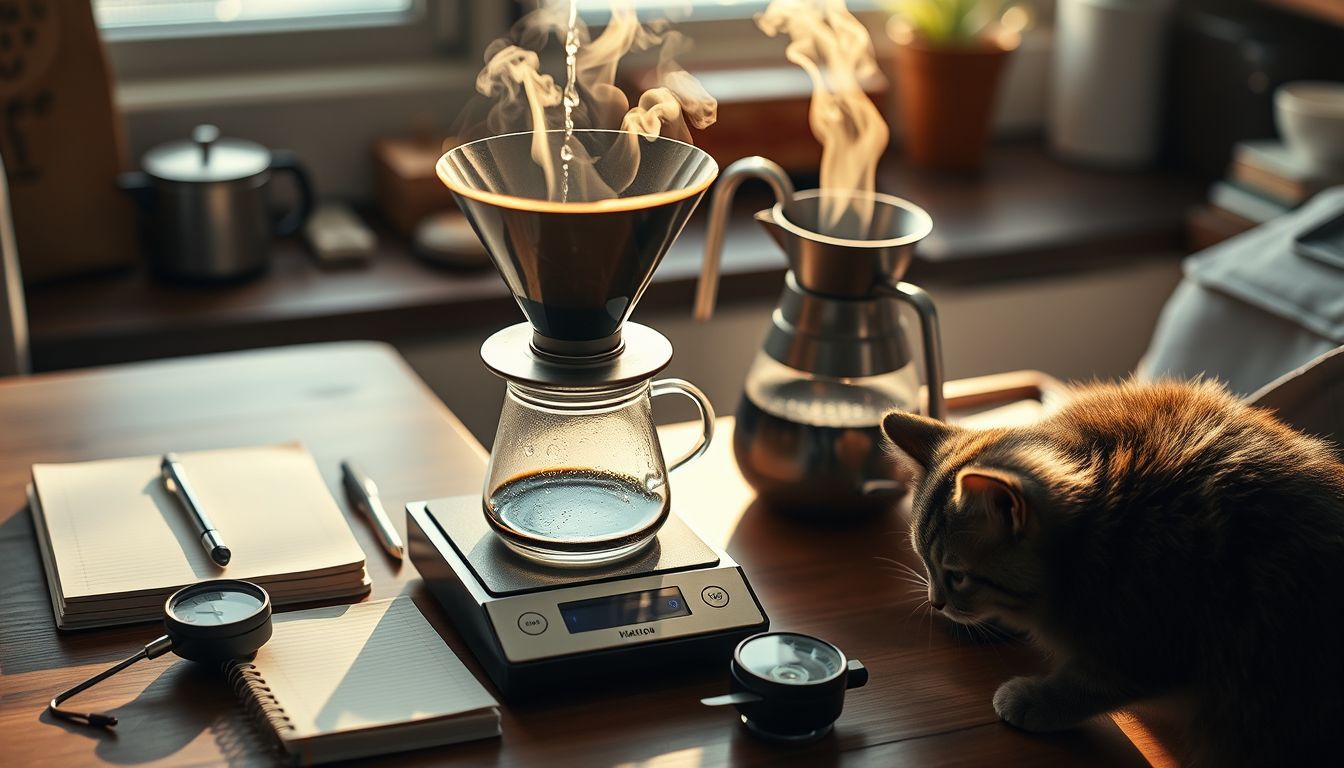
I’m Marcus Thorne—former lab scientist, current coffee obsessive in the Pacific Northwest. I live with my partner David (who has banned “kitchen refractometer incidents”) and our cat, Erlenmeyer, who believes V60 filters are toys. I came to coffee sideways after burning out in the lab and realizing I’d been running experiments on my morning brew for years.
Okay, here’s where it gets interesting: most “bitter pour-over” problems aren’t mysterious. They’re repeatable. And if they’re repeatable, you can troubleshoot them.
Below is my 2026 field guide to fix bitter pour over coffee with three levers you can control today—grind, water, and agitation—plus a simple protocol so you stop guessing.
Step 1: Confirm It’s Actually “Bitter” (Not Sour or Astringent)
Before you change anything, make sure you’re solving the right problem. People use “bitter” to describe three different sensations, and they have different causes.
Bitter vs. sour vs. astringent (the 10-second sensory test)
- Sour tastes like under-ripe lemon or green apple. It hits fast, makes you salivate, and often comes with a thin body.
- Bitter tastes like cocoa nibs, tonic water, or grapefruit pith. It lingers on the back of your tongue.
- Astringent feels like the coffee is drying your mouth—like strong black tea or red wine tannins. It’s more tactile than taste.
Bitterness and astringency often travel together in pour-over because both show up when you extract too much from some portion of the bed (especially fines) or when flow gets weird.
Actionable: Take these measurements on your next brew
Don’t change anything yet—just observe.
- Dose & ratio: Start at 20 g coffee to 320 g water (1:16).
- Water temperature: Use 205°F / 96°C for light roasts, 200°F / 93°C for medium.
- Total brew time: For a Hario V60, aim for 2:45–3:30. For a Kalita Wave 185, 3:00–4:00 is common.
If your pour over coffee too bitter with a drawdown time of 4:30+, bitterness is often a flow problem (grind too fine, too much agitation, clogged filter, too many fines). If it’s 2:00 and still bitter, your water or agitation might be overdoing it in a short window—or you’re tasting roast bitterness.
Real-world example
A washed Kenyan (say, something SL28/SL34 from a roaster like Heart or Sey) should smell like blackcurrant and citrus peel and taste like juicy berry acidity with a sweet finish.
If it smells amazing but finishes like chewing on orange pith, you’re likely over-extracting the later compounds—or concentrating fines.
Grind: The Fastest Way to Fix Bitter Pour Over (Without Making Coffee Watery)
Grind is the lever most people touch first, and for good reason: it changes both surface area and flow.
But here’s the trap I fell into for weeks (I tested this more times than I’m willing to admit): “bitter = too fine” is often true… until it isn’t. Sometimes you grind too fine, clog the bed, and get bitter. Sometimes you grind too coarse, channel like crazy, and still get bitter because parts of the bed over-extract while others under-extract.
How pour over grind size for bitterness affects your cup
- Too fine / too many fines: Slower drawdown, muddy bed, papery or drying finish. The cup feels heavy but harsh, like dark chocolate that turns chalky.
- Too coarse / channeling: Fast drawdown, uneven bed, sharpness plus bitterness—like lemon rind with burnt sugar. It can be confusing.
Actionable: Make one grind move, not five
If your brew time is long (4:00+ on a V60), go coarser.
If your brew time is short (<2:30 on a V60) and the cup is both hollow and bitter, go slightly finer and reduce agitation (we’ll get there).
As a starting point:
- Baratza Encore (classic burr): around 15–18 for V60 (varies by calibration)
- Fellow Ode Gen 2: around 4.2–5.1 for V60-style pour-over
- Comandante C40: roughly 22–28 clicks for V60
(Yes, grinders vary. Use these as “ballpark,” not gospel.) For a complete breakdown of grind consistency across price points, see our guide to the best coffee grinders for every budget and brewing method.
Why this works (human version)
Finer grind increases extraction and slows flow. If the slurry sits too long, you pull more bitter/woody compounds late in the brew. Plus, fines migrate downward, clog the filter, and create a mini “espresso puck” situation at the bottom of your V60.
This creates high resistance, high contact time, and a bitter finish.
Real example you can try
Take a natural Ethiopian (the coffee that made me fall in love with coffee was a tiny-roaster natural Ethiopia that smelled like blueberry muffins and jasmine). Naturals are often more brittle and can produce more fines.
If your natural Ethiopia tastes perfumey at first—floral, berry-like—then ends dusty and bitter, try:
- Grinding 2–3 steps coarser (Encore) or 2 clicks coarser (Comandante)
- Keeping the same ratio (1:16)
- Keeping the same water temp (205°F / 96°C)
You’re not “making it weak.” You’re restoring flow and reducing over-extraction from fines.
Water: Temperature and Chemistry (Yes, Both) Can Make Bitterness Explode
My partner would kill me for saying this, but… water is the lever that makes people roll their eyes until they taste the difference.
Two parts matter here: brew temperature and mineral balance.
Temperature: 205°F isn’t magic—here’s what’s happening
Higher temperatures increase extraction speed. That’s great for getting sweetness and acidity out of light roasts, but it can push you into bitter territory if your grind is already fine or your agitation is aggressive.
Actionable: Use this temperature map
- Light roast (washed Ethiopia, Kenya, high-grown Colombia): 204–206°F (95.5–96.5°C)
- Medium roast (most “sweet spot” blends): 200–203°F (93–95°C)
- Dark roast (or very soluble coffees): 195–199°F (90.5–93°C)
If your cup is bitter and drying, drop temperature by 2°F (1°C) before you start changing everything else.
And yes, I use a kettle like the Fellow Stagg EKG or Bonavita 1.0L so I can actually hit those numbers instead of “vibes.” Temperature control is crucial for pour-over success—learn more about why every coffee lover needs a gooseneck kettle. (I have also brought a thermometer to restaurants. I contain multitudes.)
Pour over water chemistry: How minerals create bitterness
If your water has high alkalinity (buffering), it can mute acidity and make bitterness more prominent. If it’s extremely soft or distilled, extraction can become uneven and sharp.
SCA guidance for brew water is a useful anchor: roughly 75–250 ppm TDS with moderate alkalinity. In practice, for pour-over I like:
- General hardness (as CaCO₃): ~50–90 ppm
- Alkalinity (as CaCO₃): ~30–50 ppm
Actionable: Two easy fixes you can do this week
- Use Third Wave Water (Classic Profile) with distilled/RO water for a week and see if bitterness drops.
- If you want to DIY (and I know this sounds obsessive, but bear with me), use Lotus Water drops to aim around 70 ppm hardness / 40 ppm alkalinity.
If bitterness suddenly turns into clean cocoa sweetness and the finish stops feeling like sandpaper, congratulations: you didn’t “suddenly get better at pouring.” Your minerals stopped sabotaging you.
Real example
I once dialed in an Onyx Coffee Lab washed Colombia on my V60. Same grinder, same recipe—two waters.
- With my old tap water, it smelled like panela and orange… but finished harsh, like burnt almond skin.
- With remineralized water (around 80 hardness / 40 alkalinity), it tasted like candied orange, milk chocolate, and a silky medium body.
Same coffee. Different extraction chemistry.
Agitation: When “More Even” Becomes “More Bitter”
Agitation is the sneakiest bitterness lever because it feels virtuous. You swirl, you stir, you pour hard to “make it even.”
Then your coffee tastes like you brewed it through a pencil sharpener.
What agitation actually does
Agitation increases extraction by constantly bringing fresh water into contact with coffee particles. It also encourages fines migration, which can clog the filter and slow drawdown—especially in conical brewers like the Hario V60 02.
That’s why you can get bitterness even when everything looks “textbook.”
Actionable: Use this agitation ladder (choose one level)
Pick one agitation strategy and stick to it for troubleshooting:
- Level 0 (minimal): No stir. One gentle swirl after bloom only.
- Level 1 (moderate): Gentle swirl after bloom + one swirl at the end.
- Level 2 (high): Stirring with a spoon/WDT + multiple swirls.
If you’re bitter, drop one level.
A simple, repeatable pour structure
This works well on DOWAN Pour Over dripper and is easy to repeat:
- Dose: 20 g
- Water: 320 g (1:16)
- Bloom: 50 g for 45 seconds at 205°F / 96°C
- Main pour: from 0:45 to ~1:45, pour to 200 g in slow spirals
- Final pour: to 320 g by ~2:15
- Agitation: one gentle swirl after bloom only (start here)
Aim for a drawdown around 3:00–3:30 on V60.
Equipment matters more than people admit
Flat-bottom brewers like the Kalita Wave 185 or OREA V3 tend to be more forgiving with agitation because flow is less prone to a single point of restriction.
If you’re chronically bitter on V60 despite sane grind and water, try brewing the same coffee on a Wave 185. If bitterness drops and sweetness pops—think honeyed body, soft fruit, a clean finish—you’ve learned something important: your issue might be filter geometry + fines + agitation, not your “technique.”
A 15-Minute Troubleshooting Protocol (So You Don’t Spiral)
Anyone who tells you this is simple is selling something. But it can be methodical.
Here’s how I troubleshoot bitterness when I’m dialing in a new coffee for a client—or when David walks into the kitchen, sees my scale and notebook, and asks, “Are you doing science again?”
Step A: Lock a baseline recipe
Use a known, boringly repeatable recipe for three brews:
- 20 g coffee
- 320 g water (1:16)
- 205°F / 96°C (light) or 200°F / 93°C (medium)
- 3:00–3:30 total time target
Write down: grinder setting, total time, tasting notes (especially finish).
Step B: Change only one variable per brew
If the cup is bitter/drying:
- Reduce agitation first (remove the end swirl, stop stirring).
- If still bitter, go coarser (one noticeable step).
- If still bitter, drop temp 2°F / 1°C.
This order matters because agitation and fines-related clogging can make grind changes feel inconsistent.
Step C: Use a refractometer if you’re curious (not because you “need” it)
I own vintage refractometers the way some people own vinyl records. Do you need one? Absolutely not.
But if you have access to an Atago PAL-Coffee or VST LAB Coffee III, here are helpful targets for pour-over:
- TDS: ~1.25–1.45%
- Extraction yield: ~18–22% (common “sweet spot” range)
If you’re bitter and your extraction is 23%+, you’re likely genuinely over-extracting.
If you’re bitter at 19%, the interesting answer is you might have uneven extraction—channeling plus fines clogging—where parts of the bed are over-extracted while the average looks “fine.” That’s when agitation and pour pattern usually fix more than chasing numbers.
Step D: A quick “bypass” rescue (when you just want a drinkable cup)
If you brewed too bitter but it’s otherwise aromatic—florals, fruit, nice nose—try adding 10–20 g of hot water to the finished cup.
That doesn’t remove bitterness, but it can lower intensity enough to reveal sweetness hiding underneath, like cacao turning into milk chocolate.
Frequently Asked Questions
How do I know if my pour-over is too bitter vs too sour?
Bitter tastes like cocoa nibs or grapefruit pith and lingers on your tongue. Sour tastes like lemon, hits quickly, and makes you salivate.
Should I change grind size or water temperature first?
Start with reducing agitation, then adjust grind size, then temperature. This order prevents variables from masking each other.
Can I fix bitter coffee after I’ve brewed it?
Try adding 10-20g of hot water to dilute the bitterness and reveal hidden sweetness underneath.
Conclusion: Make Bitterness Boring
Bitterness feels personal because it ruins the romance: the bright fragrance, the gentle hiss of the kettle, the tiger-striped stream of coffee dripping through the filter—then the sip lands like punishment.
But bitterness is also one of the most “fixable” problems in pour-over because it lives in levers you can control: grind that respects flow, water that extracts sweetness instead of harshness, and agitation that’s intentional—not anxious.
Tonight or tomorrow morning, pick one coffee—maybe a washed Ethiopia, maybe that chocolatey Guatemala from Counter Culture—and run the protocol. Change one variable. Taste the finish. Write one sentence.
If you do that for three brews, you won’t just fix bitter pour over coffee. You’ll build the skill that lasts: the ability to teach yourself what your coffee is asking for. Building this troubleshooting skill is similar to developing your palate—consider starting a coffee tasting journal to map flavors and track your improvements.