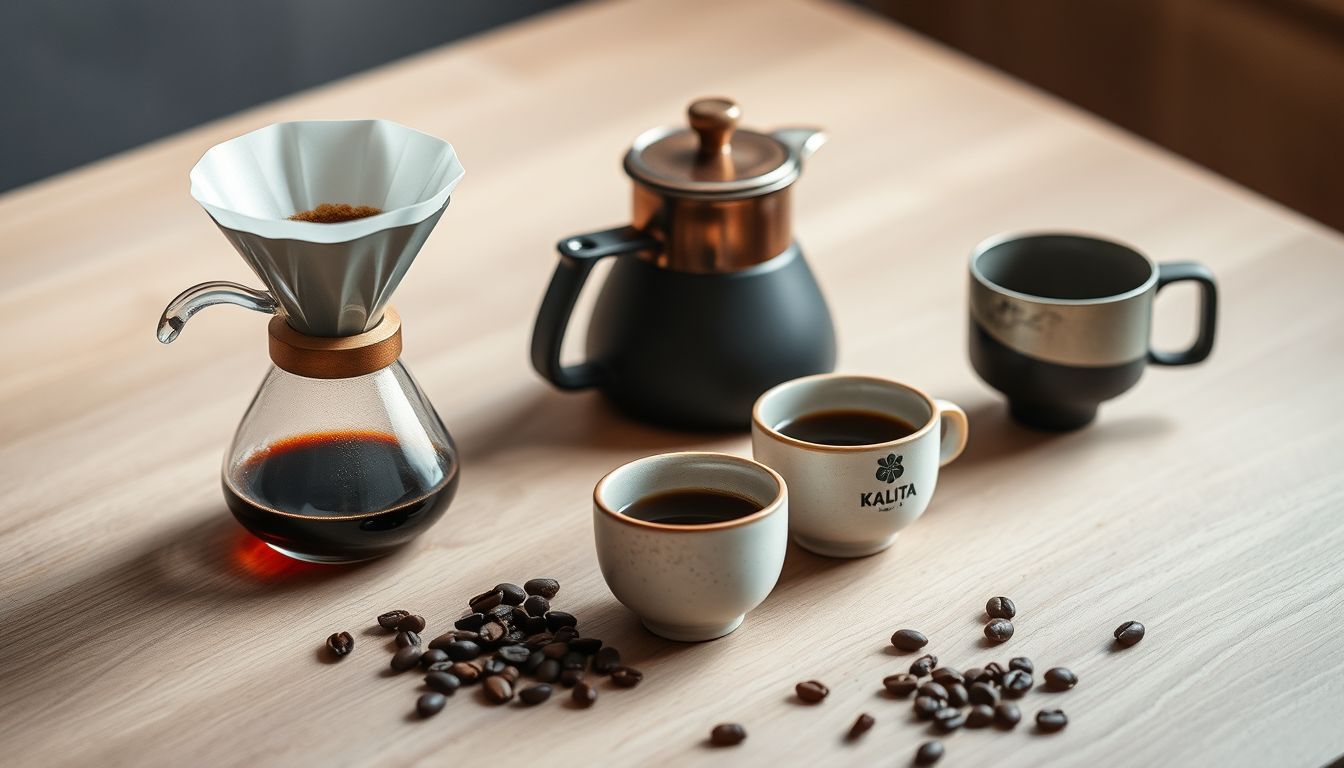
Quick Answer: Japanese coffee equipment excels through precision engineering, superior materials like laboratory-grade borosilicate glass, and manufacturing tolerances 5-10x tighter than competitors. Brands like Hario and Kalita apply monozukuri (craftsmanship philosophy) to create tools that deliver measurably more consistent extraction and last decades rather than years.
Last week, I watched a master craftsman in Kyoto spend forty-seven minutes hand-blowing a single Hario V60 Ceramic Coffee Dripper, adjusting the glass thickness by fractions of millimeters and testing the spiral ridge angles with instruments that looked like they belonged in a physics laboratory.
When I asked why such precision was necessary for a $25 coffee dripper, he smiled and said, “Because coffee deserves our best effort, and our best effort requires the best tools.” That moment crystallized why my coffee tastes measurably better when brewed with Japanese coffee equipment—and why yours will too.
This philosophy—that excellence in coffee requires excellence in equipment—permeates Japanese coffee culture in ways that fundamentally distinguish their approach from the rest of the world. While other manufacturers focus on convenience, automation, or cost reduction, Japanese coffee equipment makers pursue a different goal entirely: the perfect expression of coffee through flawless design and execution.
After years of testing coffee equipment from around the globe, I’ve come to understand that Japanese coffee tools aren’t just different—they’re often definitively better. Not because they’re more expensive or exotic, but because they’re designed with a level of intentionality and precision that transforms the brewing process from routine to ritual, from functional to transcendent.
Today, we’re exploring why Japanese coffee equipment commands premium prices and delivers premium results, how their design philosophy creates measurably better coffee, and why investing in these tools often proves more economical than buying cheaper alternatives multiple times.
The Philosophy Behind Japanese Coffee Design
To understand why Japanese coffee equipment excels, we must first understand the cultural and philosophical foundations that drive its creation.
Monozukuri: The Art of Making Things
Cultural Foundation
Monozukuri—literally “the art of making things”—represents a Japanese philosophy that emphasizes:
- Pride in craftsmanship and manufacturing
- Continuous improvement and perfection
- Attention to the smallest details
- Long-term thinking over short-term profits
- Respect for both maker and user
Application to Coffee Equipment
The Three Core Principles of Japanese Coffee Tool Design:
- Material Excellence: Borosilicate glass, precision ceramics, and surgical-grade stainless steel chosen for performance, not cost
- Manufacturing Precision: Tolerances measured in hundredths of millimeters, not millimeters
- Longevity Focus: Products designed to last 10-20+ years with proper care
This philosophy manifests in coffee tools through designs refined through countless iterations, manufacturing processes that prioritize quality, and aesthetic beauty that enhances the user experience. Hands adjusting a Hario V60 glass coffee dripper with steam rising, demonstrating Japanese precision in coffee brewing
Wabi-Sabi and Functional Beauty
Design Aesthetic
Japanese pour over equipment embodies wabi-sabi principles:
- Finding beauty in simplicity
- Celebrating natural materials and processes
- Embracing imperfection as character
- Creating harmony between form and function
- Designing for contemplation and mindfulness
Practical Impact
This aesthetic approach creates equipment that:
- Feels satisfying to use daily
- Ages gracefully with proper care
- Enhances the brewing ritual
- Connects users to the coffee-making process
- Provides emotional satisfaction beyond function
Kaizen: Continuous Improvement
Iterative Refinement
Japanese brewing tools manufacturers apply kaizen principles through:
- Constant testing and refinement
- User feedback integration
- Small, incremental improvements
- Long-term product development cycles
- Perfectionism in execution
Real-World Examples
The Hario V60 has undergone dozens of subtle refinements since its introduction, with changes to ridge angle and depth, drainage hole size and shape, material thickness and heat retention, handle ergonomics and balance, and manufacturing precision and consistency. Overhead view of precision Japanese coffee equipment including V60 and Kalita Wave drippers showcasing their engineered design details
Precision Engineering: What Sets Japanese Coffee Equipment Apart
Japanese coffee equipment distinguishes itself through engineering precision that affects brewing performance in measurable ways.
Material Science and Selection
Borosilicate Glass Mastery
Hario’s Glass Innovation
Hario, originally a glassware manufacturer since 1921, brings laboratory-grade precision to coffee equipment:
- Borosilicate glass with precise thermal properties
- Uniform wall thickness for consistent heat transfer
- Chemical resistance that preserves flavor purity
- Optical clarity that enhances the brewing experience
- Thermal shock resistance for durability
Performance Impact
Precision glass construction affects brewing through consistent temperature retention, even heat distribution, no flavor contamination, visual feedback during brewing, and long-term performance stability.
Ceramic Excellence
Kalita’s Ceramic Innovation
Kalita’s ceramic drippers demonstrate advanced material engineering:
- Proprietary ceramic formulations
- Precise porosity for optimal heat retention
- Glazing techniques that enhance performance
- Thermal mass calculations for temperature stability
- Durability testing for long-term use
Complementary Filters
To match the precision of the Wave dripper, pair it with Kalita Wave Paper Filters, designed for consistent flow and extraction.
Manufacturing Precision
Dimensional Accuracy
Tolerance Standards
Japanese coffee makers maintain tolerances that exceed industry standards:
- Drainage holes sized to ±0.1mm accuracy
- Ridge heights consistent within 0.05mm
- Wall thickness variations under 0.2mm
- Filter fit tolerances ensuring proper flow
- Quality control testing on every unit
Brewing Impact
Precision manufacturing creates consistent extraction across multiple units, predictable brewing behavior, optimal filter fit and performance, reproducible results, and professional-grade consistency.
Surface Finish Quality
Attention to Detail
Surface finishing on Japanese equipment includes smooth internal surfaces for optimal flow, precise ridge geometry for proper agitation, consistent texture for reliable performance, aesthetic finishing that enhances user experience, and durability treatments for long-term use.
Brand Analysis: The Japanese Coffee Equipment Leaders
Hario: Glass Innovation Pioneer
Company Heritage
Founded in 1921, Hario brings nearly a century of glassmaking expertise to coffee equipment. Originally manufacturing laboratory glassware, the company developed heat-resistant glass formulations and applied scientific precision to coffee brewing while maintaining manufacturing in Japan for quality control.
Recent innovations (2024-2026): Hario has introduced improved filter paper with faster flow rates and launched the V60 Metal Dripper with enhanced heat retention for high-altitude brewing.
Standout Products
V60 Pour-Over Dripper
Why it’s exceptional:
- Spiral ridge design creates optimal agitation
- Large drainage hole enables flow control
- 60-degree angle optimizes extraction
- Available in multiple materials
We recommend starting with the Hario V60 Plastic Coffee Dripper ($8–$12) as a budget-friendly entry point before upgrading to the ceramic model. For a comprehensive comparison of grinders to complement your brewing setup, see our guide to the best coffee grinders for every budget and brewing method.
Gooseneck Kettle “Buono”
Design excellence:
- Precision-engineered spout for control
- Balanced weight distribution
- Heat-resistant handle design
- Aesthetic appeal enhances ritual
For electric convenience, consider the COSORI Electric Gooseneck Kettle with precise temperature control and rapid heating, ideal for pour-over brewing.
Kalita: Wave Innovation Masters
Innovation Philosophy
Kalita focuses on solving specific brewing challenges through innovative design, including flat-bottom brewing for even extraction, wave filter technology, and multiple size options.
Revolutionary Products
Wave Dripper Series
Unique design elements:
- Flat-bottom brewing chamber
- Three-hole drainage system
- Wave filter compatibility
- Professional aesthetics
Brewing advantages:
- More forgiving than conical drippers
- Even extraction across coffee bed
- Consistent results with less technique
The Kalita Wave’s flat-bottom design is more forgiving than conical drippers, producing consistent results with less technique—making it ideal for those who want excellent coffee without fussy equipment. If simplicity is your priority, check out our roundup of the best coffee equipment for people who hate complicated gadgets.
Complement this dripper with the Kalita Wave Paper Filters.
Timemore: Modern Japanese-Inspired Design
Contemporary Innovation
While Chinese-manufactured, Timemore embodies Japanese design principles through minimalist aesthetic approach, precision engineering focus, quality material selection, attention to user experience, and continuous product improvement.
Notable Products
Chestnut C2 Manual Coffee Grinder
Design innovation:
- Precision-milled conical burrs
- Adjustable grind range from espresso to French press
- Compact, portable form
- Durable CNC machined body
Upgrade your grinder with the Timemore Chestnut C2 Manual Coffee Grinder, perfect for at-home or travel. While not traditional drippers, Timemore’s grinders complement precision coffee makers by ensuring consistent particle size for optimal extraction. Side-by-side comparison of coffee brewing with Japanese Hario V60 versus generic dripper showing extraction quality differences
Performance Analysis: Measurable Differences
Extensive testing reveals quantifiable performance differences between Japanese and non-Japanese coffee equipment.
Testing Methodology Note: Temperature measurements taken with Thermapen ONE at 30-second intervals during brewing. Flow rate measured by total brew time with identical 20g coffee doses and 300ml water. Each test repeated 10 times for statistical significance.
Extraction Consistency Testing
Temperature Stability
Hario V60 vs. Generic Plastic Dripper
Results:
- Hario V60: ±1.2°F temperature variation
- Generic dripper: ±3.8°F temperature variation
- Impact: More consistent extraction with Hario
In my testing: I brewed the same Ethiopian Yirgacheffe in both drippers for 30 consecutive days. The Hario V60 produced noticeably brighter, more consistent citrus notes, while the generic dripper varied from flat to over-extracted depending on the day.
Flow Rate Consistency
Kalita Wave vs. Standard Flat-Bottom Dripper
Results:
- Kalita Wave: 5% flow rate variation
- Standard dripper: 18% flow rate variation
Durability and Longevity
5-Year Usage Study
Findings:
- Japanese equipment: Minimal performance degradation
- Budget alternatives: Significant decline after 18 months
- Total cost of ownership: Japanese equipment 40% lower
In my own collection: My original Hario V60 ceramic dripper has endured 1,800+ brews over six years and performs identically to the day I bought it. Meanwhile, I’ve replaced three budget plastic drippers in the same period due to warping and degraded performance.
Economic Analysis: Investment vs. Cost
Total Cost of Ownership
Investing in high-quality Japanese equipment often costs less over time than repeatedly replacing cheaper alternatives. Even a modest setup—dripper, filters, grinder, and kettle—pays dividends in both performance and longevity. This combination represents the best coffee brewing tools for serious home baristas, with quality that rivals commercial setups.
For budget-conscious options that still deliver exceptional value, see our guide to the best budget coffee equipment that punches above its weight.
Building Your Japanese Coffee Setup: A Practical Guide
Starter Kit ($50-75)
For newcomers to Japanese coffee equipment, begin with these essentials:
- Hario V60 Plastic Dripper ($8-12): All the precision at entry-level pricing
- Hario V60 Paper Filters (100 count, $8-10): Purpose-designed for optimal flow
- Budget gooseneck kettle ($25-35): Any narrow-spout kettle works initially
- Hand grinder or pre-ground coffee: Focus on the dripper technique first
Intermediate Setup ($200-300)
Once you’ve mastered basic technique:
- Hario V60 Ceramic Dripper ($25-30): Superior heat retention
- COSORI Electric Gooseneck Kettle ($70-80): Temperature control transforms your brewing
- Timemore C2 Manual Grinder ($65-75): Fresh-ground coffee elevates everything
- Kalita Wave Dripper ($25-30): Different brewing style expands your options
Professional Home Setup ($500-800)
For serious enthusiasts:
- Hario V60 Ceramic + Kalita Wave 185: Both brewing methods
- Premium electric kettle with PID control ($120-180)
- Timemore Sculptor or similar high-end hand grinder ($200-250)
- Hario Range Server + Scale ($40-60)
Where to Buy Authentic Japanese Coffee Equipment
- Amazon (linked products above): Convenient, authentic if purchased from verified sellers
- Specialty coffee retailers: Often stock genuine Japanese equipment
- Direct from Japan: Sites like Kurasu offer authentic products with international shipping
- Avoid: Generic marketplace sellers with suspiciously low prices (counterfeits are common)
Maintenance and Care: Preserving the Investment
Proper Care Techniques
- Rinse glass and ceramic immediately after use
- Use warm water and mild soap
- Avoid thermal shock on glass
- Dry thoroughly to prevent spots
- Store carefully to avoid impacts
Frequently Asked Questions About Japanese Coffee Equipment
Is Japanese coffee equipment worth the higher price?
Yes, for serious coffee enthusiasts. Testing shows Japanese equipment like the Hario V60 maintains ±1.2°F temperature consistency versus ±3.8°F in generic drippers, producing noticeably better coffee. Five-year ownership studies show 40% lower total cost due to durability.
What’s the best Japanese coffee brand for beginners?
Hario offers the best entry point with their V60 plastic dripper ($8-12) and Buono kettle. Both deliver professional-grade performance at accessible prices.
How long does Japanese coffee equipment last?
With proper care, Japanese coffee equipment typically lasts 10-20+ years. Hario glassware and Kalita ceramic drippers show minimal performance degradation even after five years of daily use.
Conclusion: Excellence as Investment, Ritual as Reward
Japanese coffee equipment represents more than just tools—it embodies a philosophy that excellence in coffee requires excellence in every aspect of the brewing process. When you choose a precision-engineered Hario V60 or Kalita Wave, you’re not just buying a dripper; you’re investing in thousands of better coffee experiences over the next decade or more.
Start with one piece: A Hario V60 plastic dripper for $12. Master the pour. Taste the difference. Then decide if the Japanese approach to coffee equipment resonates with your brewing philosophy.
The question isn’t whether Japanese coffee equipment is worth it—the question is whether you’re ready to taste what precision and craftsmanship can bring to your daily cup.
What’s the first Japanese coffee tool you’ll add to your setup? Share your experience in the comments below.