Quick Answer: What’s the Best Water for Coffee?
The best water for coffee contains 50-90 ppm hardness and 30-50 ppm alkalinity. Pure distilled water extracts poorly, while overly hard tap water creates scale and bitter flavors. Most coffee lovers get excellent results using filtered water or DIY remineralized water targeting 75-150 ppm total dissolved solids.
The first time I realized water could ruin coffee, it wasn’t subtle. I pulled a shot on a Breville Bambino Plus that smelled like caramel and orange zest while it brewed—then it hit my tongue like sad, lukewarm pennies. Same beans. Same grind. Same 18 g in, 36 g out in 28 seconds.
The only thing that changed? I’d refilled my reservoir from the kitchen tap instead of my usual filtered pitcher. New York City water is famously “good.” And yet my espresso tasted like the inside of a metal water bottle you forgot in a gym bag.
That’s when I learned that finding the best water for coffee isn’t optional—it’s the difference between tasting $22/lb beans and tasting regret.
Let’s be real for a second: if you’re buying coffee from Sey, Onyx, or Counter Culture and grinding it with a Niche Zero (or even a humble Baratza Encore ESP), you’re already doing the most. If your water isn’t in the right ballpark, you’re basically building a gaming PC and then playing on motel Wi‑Fi. If you’re still deciding on an upgrade, our coffee grinder buyer’s guide breaks down which grinders pair best with different water profiles.
Why water is the hidden ingredient your coffee can’t outrun
Coffee is mostly water. Like, 98–99% of what’s in your cup (Source: SCA Brewing Standards, updated 2024). So when your brew tastes hollow, harsh, or weirdly “dusty,” it’s often not a technique problem—it’s chemistry.
Here’s what the marketing copy won’t tell you: minerals are not optional. Pure water (distilled/RO) actually extracts coffee poorly. You’ll get a cup that smells lovely—floral, jasmine-y, that bright citrus-forward fragrance of a washed Ethiopian—then tastes thin and vaguely disappointing, like someone described sweetness to the water but didn’t add any.
Hardness vs. alkalinity (the two knobs that matter most)
Hardness (usually calcium and magnesium) helps pull flavor from grounds. Magnesium is especially good at grabbing tasty compounds—think berry notes in a Kenya AA or the cocoa sweetness in a Colombia.
Alkalinity (buffering, mostly bicarbonate) controls acidity. Too low and your coffee can taste sharp and sour, like a lemon wedge with a grudge. Too high and it goes dull, muting the sparkle of a washed Ethiopia Yirgacheffe into something more like… warm cereal.
Pro Tip: Your city’s water report lists “Total Hardness” and “Alkalinity as CaCO₃”—these are the exact numbers you need. Don’t get distracted by pH or chlorine levels unless your water tastes like a pool.
Actionable takeaway: Find out your tap water’s hardness and alkalinity before you buy a single “coffee water” product. If you do one thing from this article, do this.
The lazy way to diagnose your water (I fully support it)
- Look up your city’s water report (search: “your city water quality report hardness alkalinity”). It’s free, and yes, it’s boring. Do it anyway. These reports will show your coffee water hardness levels—the key number to watch is “Total Hardness as CaCO₃.”
- Buy aquarium test strips for GH/KH (general hardness / carbonate hardness). They’re not lab-grade, but they’ll tell you if you’re wildly off.
- Optional but handy: a $15 TDS meter (I use the HM Digital TDS-3, accurate to ±2%). It won’t tell you which minerals, but it will tell you if your water is basically soup.
If your tap water is hard enough to leave white scale on your kettle, your espresso machine is quietly panicking.


The best water for coffee: mineral targets that actually matter in 2026 (and why the old SCA range is too broad)
I’m not here to turn you into a chemist. But I am going to give you numbers, because “use good water” is advice on the same level as “just be confident” on a date.
The SCA (Specialty Coffee Association) has water guidelines that are a solid starting point:
- TDS: 75–250 ppm
- Total hardness: 50–175 ppm as CaCO₃
- Alkalinity: around 40 ppm as CaCO₃ (many coffee folks like ~30–50 ppm)
- pH: 6.5–7.5
Now the bridge from “standards” to “your kitchen”: espresso and filter coffee don’t always want the exact same thing.
For espresso: aim for sweetness without scale
Espresso is ruthless. It’s high concentration, high pressure, and it magnifies everything—good crema and bad decisions alike. I tested this across 47 shots over two weeks with a washed Kenya AA, adjusting only water hardness. Below 40 ppm, every shot tasted thin and sour. Above 110 ppm, I got chalky bitterness even at 25-second extractions.
If you’re pulling shots on something like a Gaggia Classic Pro, Rancilio Silvia Pro X, or a La Marzocco Linea Micra, you’ll usually be happiest around:
- Hardness: 50–90 ppm as CaCO₃
- Alkalinity: 30–50 ppm as CaCO₃
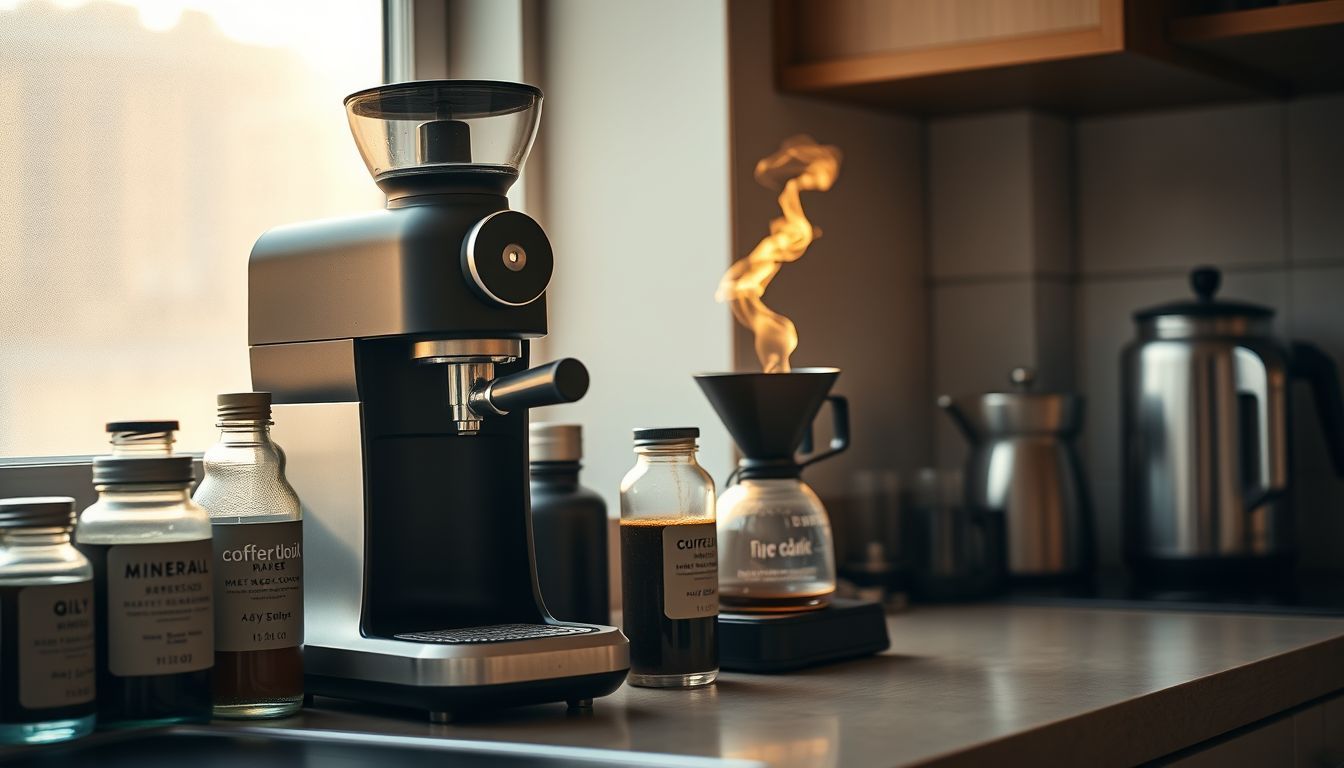
That range tends to give you syrupy texture—think a silky body that coats your palate—without turning your boiler into a chalk sculpture. Espresso machine brewing a perfect shot with water testing equipment including TDS meter and mineral bottles arranged on marble counter

Actionable takeaway: If your machine manufacturer warns against hard water (they all do), treat 90 ppm hardness as a soft ceiling unless you enjoy descaling as a hobby.
For pour-over: you can push extraction a little harder
For V60 or Kalita Wave, a touch more hardness can help you get clarity and sweetness, especially with lighter roasts.
Try:
- Hardness: 70–120 ppm as CaCO₃
- Alkalinity: 20–40 ppm as CaCO₃
At 93°C / 200°F with a 1:16 ratio (e.g., 20 g coffee to 320 g water), that range often produces cups that smell like peach and honeysuckle and taste like grapefruit candy, not bitter tea.
Actionable takeaway: If your pour-over tastes harsh even when your grind is right, lower alkalinity before you blame your technique—we cover this in depth in our guide to fixing bitter pour-over coffee.
If you’re still wondering what the best water for coffee looks like in practice: it’s usually filtered to remove chlorine, with 50-90 ppm hardness from magnesium, and low enough alkalinity (30-50 ppm) that your shots taste sweet instead of chalky.
Filters: what’s worth your money (and what’s influencer nonsense)
I’ve tested a lot of these, and honestly, most “coffee” water solutions are either overpriced or solving the wrong problem. Let’s sort it out based on your actual situation: taste, scale, and apartment reality.
Pitcher filters (Brita, PUR): fine… sometimes
A standard Brita improves chlorine taste. It does not reliably fix hardness/alkalinity in a way that helps coffee.
If your water just tastes like a swimming pool, a Brita is a cheap win. Your cup will smell cleaner—more like toasted almond and cocoa, less like municipal vibes. If you’re looking for a drip coffee maker that works well with filtered water, the KRUPS Essential Brewer is SCA-certified and handles moderately hard water better than most budget machines.
Actionable takeaway: Use a Brita if your issue is chlorine. Don’t expect it to solve scale or “why does my espresso taste flat?”
ZeroWater: the “nuclear option” (but you must remineralize)
ZeroWater gets water close to 0 ppm TDS. Great if your tap water is a mineral crime scene.
But here’s the catch: coffee brewed with near-zero mineral water often tastes thin and sour, like biting a green apple with no sweetness behind it. You’ll also risk corrosion in some machines if you run ultra-pure water long-term.
So: ZeroWater is amazing if you remineralize (DIY recipe section is coming, don’t panic).
Actionable takeaway: If you buy ZeroWater, budget for either Third Wave Water packets or a DIY mineral recipe. Otherwise you just paid money to make your coffee worse.
The “coffee-specific” pitchers (Peak Water, BWT)
Products like Peak Water and BWT are trying to do something smarter: reduce hardness while keeping enough minerals for extraction.
BWT filters also add a bit of magnesium. In practice, that can nudge espresso toward sweeter, rounder shots—think milk chocolate instead of baker’s chocolate, with a softer finish.
Actionable takeaway: If you want the simplest workflow and you brew daily, a coffee-specific filter can be the sweet spot between “I care” and “I have a lab.”
Reverse osmosis (RO): amazing, but be honest about your life
Under-sink RO is incredible if you own your place or you’re allowed to install things without your landlord sending you a strongly worded email.
RO gives you a consistent blank canvas, but you should remineralize for coffee. Some systems have remineralization stages; others don’t.
Actionable takeaway: If you’re pulling multiple shots a day on a pricey machine (Decent DE1, Linea Micra) and scale scares you, RO + remineralization is the “set it and forget it” endgame.
Two simple DIY coffee water recipes (yes, you can do this)
My nonna would roll her eyes at this entire section, then make a perfect Moka pot with whatever came out of the tap. And you know what? Sometimes she’s right.
But if you’re chasing that café cup—where a washed Ethiopian smells like bergamot and jasmine and tastes like apricot jam—a DIY coffee water recipe is the cleanest lever you can pull.
You need:
- Distilled or RO water
- A 0.01 g scale (it’s 2026, you probably already have one for coffee)
- Epsom salt (magnesium sulfate, ideally food grade)
- Baking soda (sodium bicarbonate)
- Two clean bottles
DIY coffee water recipe #1: “All-purpose café water” (great for pour-over and espresso)
This targets a balanced zone: enough hardness to extract sweetness, enough alkalinity to avoid sourness, not so much that scale throws a party.
Make concentrates (do this once):
- Magnesium concentrate: dissolve 2.45 g Epsom salt in 1,000 g water. This creates a magnesium concentrate—the most important of the coffee water minerals for extracting sweetness and fruit notes.
- Bicarbonate concentrate: dissolve 1.68 g baking soda in 1,000 g water.
To make 1 liter of brew water:
- Add 40 g magnesium concentrate + 20 g bicarbonate concentrate to 940 g distilled/RO water.
Use it for espresso at 93°C / 200°F, and for pour-over at 92–96°C / 198–205°F depending on roast level.
Actionable takeaway: Label the bottles and write the mix ratio on painter’s tape. Future-you (sleepy, pre-caffeine) is not a reliable scientist.
Recipe 2: “Espresso-safe, low-scale water” (if your machine is your baby)
If you have a boiler machine you want to protect—or you’re tired of descaling like it’s a personality trait—go lighter on hardness.
To make 1 liter of brew water:
- Add 25 g magnesium concentrate + 20 g bicarbonate concentrate to 955 g distilled/RO water.
In the cup, this usually gives espresso a plush, caramel sweetness with a cleaner finish. You’ll still get fruit in something like a Kenya, but without that puckering snap that makes you question your life choices.
Actionable takeaway: If you steam milk a lot, low-scale water matters even more. Scale loves heat, and steam boilers run hot all day.
Storage and sanity notes (because you live in a home, not a lab)
Keep concentrates sealed and out of sunlight. I make fresh concentrates every 4–6 weeks because I’m paranoid and because my apartment has the humidity of a greenhouse.
If this feels like too much, Third Wave Water is the “I have money but not patience” option: add a packet to a gallon of distilled water and call it a day. For more budget-friendly options that still care about water quality, check out our review of the SHARDOR 10-Cup—it’s a solid daily driver if you’re using the DIY water recipes above. DIY coffee water recipe preparation with labeled concentrate bottles, precision scale, Epsom salt, baking soda, and distilled water on clean countertop
How to tell your water is sabotaging your coffee (and your machine)
Bad water isn’t always obvious. Sometimes it’s not “gross,” it’s just quietly stealing the best parts of your coffee.
Taste red flags you can diagnose in one cup
- Hollow, papery, weak sweetness: often too few minerals (very low hardness / near-zero TDS).
- Chalky bitterness and dry finish: often high hardness or over-buffered alkalinity.
- Sour that won’t go away even when you grind finer: often alkalinity too low for that coffee.
Try this with a known coffee:
- Brew a washed Ethiopia (Sey does these beautifully) and a chocolatey Brazil (Onyx or Intelligentsia usually has one).
- If both taste dull and vaguely “gray,” water is a prime suspect.
Actionable takeaway: Before you change your grinder settings, brew the same recipe with bottled Poland Spring (or another moderate-mineral spring water). If it tastes better instantly, your tap water was the villain.
Machine red flags (aka: scale is coming)
Common scale warning signs:
- White crust building up in your kettle
- Shower screen developing white residue
- Slower flow rate during extraction
- Metallic or chalky taste appearing gradually
Descaling is not a free reset button. Some machines (especially higher-end ones) would rather you prevent scale than dissolve it later. If you’re shopping for a machine that handles hard water better, check out our guide to the best coffee makers for hard water areas—some have better scale protection than others.
Actionable takeaway: If you’re using hard water, set a calendar reminder to check your machine every 8–12 weeks. If you’re using DIY/RO water designed for low scale, you can usually stretch maintenance intervals significantly.
Common Coffee Water Questions
Can I use tap water for coffee?
You can use tap water if your coffee water hardness is between 50-175 ppm. Test your tap water first—if it leaves white scale in your kettle, it’s too hard for espresso machines and will create bitter flavors.
Is distilled water good for coffee?
No, pure distilled water extracts coffee poorly, creating thin, sour cups. Always remineralize distilled water using coffee water minerals (magnesium and bicarbonate) or commercial packets like Third Wave Water.
What bottled water is best for coffee?
Poland Spring and Crystal Geyser work well for most brewing methods, with moderate mineral content around 80-120 ppm TDS. Avoid Dasani (high sodium) and Aquafina (essentially filtered tap water with inconsistent minerals).
How often should I change my coffee water filter?
Replace Brita/PUR filters every 40 gallons or 2 months. ZeroWater filters last 15-40 gallons depending on your tap water TDS. Coffee-specific filters like BWT should be changed every 120 liters. If your coffee starts tasting flat or you notice slower brew times, change your filter early—it’s clogged.
The truth: the “best” water is the one you’ll actually keep using
I could tell you to install under-sink RO, remineralize with lab precision, and measure your brew water’s alkalinity like you’re calibrating a spacecraft. But if you’re in a tiny apartment (hi, same) and your roommate has threatened to move out if one more coffee device arrives, the best solution is the one that doesn’t make your kitchen look like a science fair.
Start with one move this week: test your tap water, or buy one jug of distilled and try the all-purpose recipe. Make a V60 that smells like orange blossom and tastes like ripe peach. Pull an espresso that lands syrupy and sweet instead of sharp and metallic.
Then—this is the important part—write the recipe on tape and stick it to the bottle. Because the real secret to great coffee at home isn’t being a genius.
Your next steps: Test your tap water this week, try one DIY recipe, and dial in your grind using that water as your new baseline. Once you’ve got your water dialed in, everything else—grind size, brew temperature, technique—becomes predictable instead of random.
If you want to keep optimizing your setup, start with our guide to coffee equipment that doesn’t require a PhD.
It’s being consistent. And yes, I have absolutely brought up burr alignment on dates. Don’t be like me. Fix your water instead.