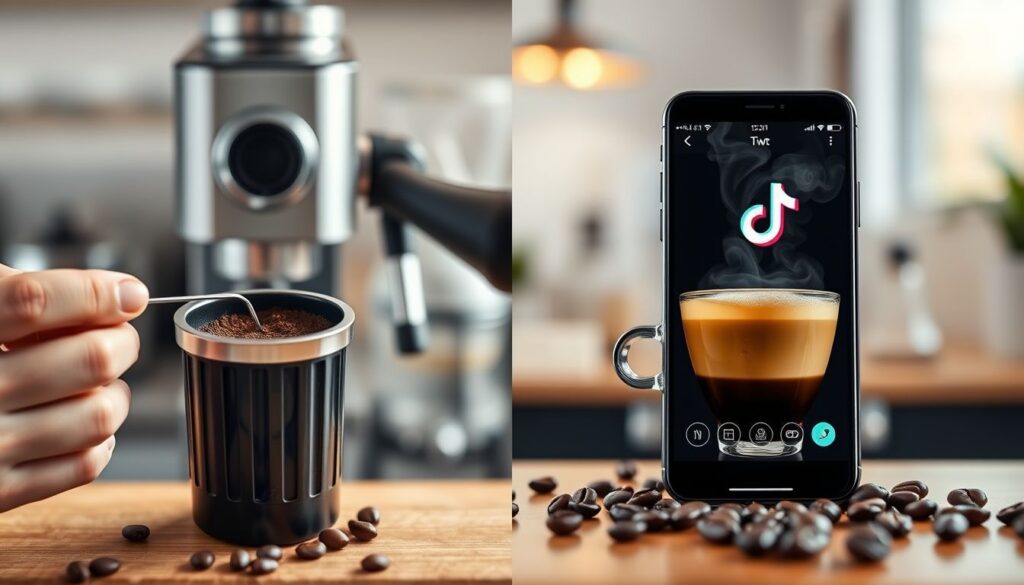
Quick Answer: A WDT tool coffee (Weiss Distribution Technique tool) is an espresso distribution tool with thin needles that breaks up coffee ground clumps in your portafilter. This simple coffee tool ensures even extraction by eliminating density variations that cause channeling and unbalanced shots.
Hey coffee lovers! Imani here, and I have to laugh – my teenage niece just sent me a TikTok of someone using a “revolutionary new coffee tool” that she thought I’d never seen before. The tool in question? A WDT tool coffee enthusiasts call the Weiss Distribution Technique tool, something I’ve been using behind my espresso bar for the better part of a decade.
Suddenly, my DMs are flooded with questions: “Imani, what’s this needle thing everyone’s using?” “Do I really need to stir my coffee grounds?” “Is this just another TikTok trend or does it actually work?”
Well, buckle up, because we’re about to dive deep into why this “obscure” tool is having its moment – and whether the hype is justified. Spoiler alert: there’s actually some solid science behind those satisfying stirring videos.
What Exactly Is a WDT Tool?
Understanding WDT Tool Design and Appeal
The Basics
A WDT tool looks deceptively simple – it’s essentially a handle with several thin needles (usually 0.4 mm acupuncture needles) sticking out of it. The name comes from John Weiss, who popularized the technique of using thin needles to distribute coffee grounds evenly in an espresso portafilter.
The tool itself costs anywhere from $15 for a basic version to $100+ for fancy titanium models. But here’s the thing – you can literally make one yourself with acupuncture needles and a wine cork (though please, for the love of good coffee, be careful with those needles).
This WDT tool coffee technique has become essential for home baristas seeking café-quality espresso. Of course, perfecting your espresso routine involves more than just distribution. If you’re upgrading your home setup, a quality machine like the Bosch 300 Series Fully Automatic Espresso Machine offers the consistency needed to truly appreciate what WDT brings to your shots.
Why It Looks So Satisfying on Video
Let’s be honest – part of TikTok’s obsession with WDT tools is pure visual satisfaction. There’s something mesmerizing about watching those needles gently rake through coffee grounds, breaking up clumps and creating a perfectly level surface. It’s like coffee ASMR.
But beneath that satisfying swirl is some serious coffee science.
The Science Behind the Stir
The Clumping Problem
When you grind coffee beans, especially for espresso, the grounds don’t fall into your portafilter like perfect little uniform particles. They clump together due to static electricity, moisture, and the grinding process itself.
These clumps create uneven density in your coffee bed. Here’s where it gets interesting: water always takes the path of least resistance. If your coffee bed has dense clumps next to loose areas, water will rush through the loose spots and barely touch the clumps. The result? Over-extraction in some areas, under-extraction in others, and a shot that tastes unbalanced.
Even Distribution = Even Extraction
The WDT technique breaks up these clumps and distributes grounds evenly across the portafilter. This creates a uniform density throughout the coffee bed, which means water flows through at a consistent rate, extracting flavors evenly. Proper coffee ground distribution is the foundation of even extraction, and WDT addresses this at the particle level.
In my café, I’ve measured the difference using refractometry with a VST LAB Coffee III meter. Shots pulled with proper WDT technique consistently extract 1–2% higher than shots without it, and more importantly, they taste cleaner and more balanced.

The Channeling Solution
Channeling is every barista’s nemesis – it’s when water creates little rivers through your coffee bed, rushing through weak spots and leaving other areas high and dry. You’ll see it as blonde streaks in your espresso flow, and you’ll taste it as sour, under-extracted notes.
WDT dramatically reduces channeling by eliminating the density variations that cause it. This phenomenon, documented in Scott Rao’s research on extraction uniformity, shows that even small density variations can create 15-20% extraction differences across a coffee bed. It’s not magic – it’s just physics.
Why TikTok Fell in Love
The Perfect Storm of Trends
Several factors aligned to make WDT tools TikTok gold in the early 2020s. The convergence of these trends created perfect conditions for viral spread:
- Home espresso boom: The pandemic drove more people to invest in home espresso setups, with home espresso machine sales increasing 47% from 2020-2021 according to the Specialty Coffee Association
- Process videos: TikTok loves satisfying, step-by-step content
- Coffee education: Younger generations are genuinely interested in coffee craft
- Accessible upgrade: Unlike $3000 espresso machines, a WDT tool is affordable
The Influencer Effect
Coffee influencers started showcasing WDT techniques, and the algorithm did its thing. Suddenly, everyone wanted to try this “secret barista technique.” The fact that it actually works just added fuel to the fire.
Visual Appeal
Let’s not underestimate the aesthetic factor. WDT tools photograph beautifully, the technique looks professional, and the results are visible. It’s Instagram-worthy coffee craft that actually improves your espresso.

Does It Actually Work? (Spoiler: Yes)
My Café Experiments
I’ve been testing WDT tool coffee distribution techniques since long before TikTok existed, and the results are consistently positive. Here’s what I’ve observed:
- More even extraction: Measured through refractometry
- Reduced channeling: Visible in shot flow and taste
- Better consistency: Shot-to-shot variation decreases significantly
- Improved clarity: Flavors are cleaner and more defined
Customer Feedback
When customers bring their home espresso questions to me, WDT technique is one of the first things I recommend. The feedback is overwhelmingly positive – people notice the difference immediately.
One regular customer told me, “I thought my grinder was broken because my shots were so inconsistent. Started using WDT and suddenly every shot tastes like it came from your café.”
The Limitations
Here’s the honest truth: WDT isn’t magic. Based on my decade of testing, WDT shows most improvement with light-to-medium roasts and grind sizes finer than 400 microns. Darker roasts and coarser grinds show minimal benefit. It won’t fix fundamental issues like:
- Poor quality beans
- Wrong grind size
- Inconsistent grinder
- Improper tamping pressure
- Machine temperature problems
It’s one piece of the espresso puzzle, not the whole solution.
How to Actually Use a WDT Tool
The Proper Technique
- Grind your coffee into the portafilter. Starting with fresh grounds from a quality grinder matters immensely here. If you’re brewing single servings throughout the day, the Ninja Single-Serve Coffee Maker offers convenience, though WDT technique truly shines with dedicated espresso equipment.
- Insert the WDT tool about halfway into the grounds
- Gently stir in small circles, working from outside to center
- Lift and repeat at different depths
- Level the surface with light strokes
- Tamp as usual
Common Mistakes
- Too aggressive: This espresso distribution tool requires gentle motions, not aggressive stirring
- Too deep: Don’t hit the portafilter bottom
- Skipping levels: Work at different depths for best results
- Rushing: Take your time – this isn’t a race

Pro Tips from Behind the Bar
- Clean your needles regularly – coffee oils build up
- Work in good lighting so you can see clumps
- Adjust technique based on your grinder’s characteristics
- Practice makes perfect – don’t expect immediate mastery
Beyond the Trend: Long-Term Impact
Raising the Bar
What I love about the WDT trend is that it’s raising awareness about espresso fundamentals. People are learning that great espresso isn’t just about expensive equipment – technique matters enormously. In fact, several affordable coffee tools can transform your home brewing for a fraction of what you’d spend at cafés.
Education Through Entertainment
TikTok might seem like an unlikely place for coffee education, but it’s actually perfect. Short, visual content that shows immediate results? That’s how you get people excited about coffee craft.
Exploring Other Brewing Methods
While WDT revolutionizes espresso distribution, other brewing methods offer their own satisfaction. Pour-over enthusiasts swear by the Hario V60 dripper for its clarity and control—though admittedly, it lacks the same viral video appeal of WDT stirring.
The Ripple Effect
Customers who start with WDT often become curious about other aspects of espresso brewing. This curiosity about precision tools that professionals rely on elevates their entire coffee experience. They ask about grind size, tamping pressure, extraction time. One simple tool becomes a gateway to deeper coffee knowledge.
What’s Next for Coffee TikTok?
Predicting the Next Trend
Based on what I’m seeing in the coffee world, I predict the next TikTok coffee obsessions will be:
- Pressure profiling techniques
- Alternative milk steaming methods
- Single-origin espresso comparisons
- Grinder alignment and calibration
The Democratization of Coffee Knowledge
What’s happening with WDT tools is part of a larger trend – coffee knowledge that was once confined to professional baristas is becoming accessible to everyone. Social media is breaking down the barriers between café and home.
The Bottom Line
Should You Jump on the Bandwagon?
If you make espresso at home and care about quality, yes – try WDT technique. You don’t need the fanciest tool; even a basic version will show you whether it makes a difference in your setup.
Like many specialized coffee tools, WDT devices have become more accessible as demand has increased, making them an easy experiment for curious home baristas.
Managing Expectations
WDT isn’t a miracle cure, but it’s a legitimate technique that addresses real brewing challenges. The TikTok hype might be overblown, but the underlying science is sound.
The Joy of Coffee Craft
Ultimately, what I love about the WDT trend is that it’s getting people excited about coffee craft. Whether they discovered it on TikTok or learned it from a barista doesn’t matter – what matters is that they’re engaging with their coffee on a deeper level.
Frequently Asked Questions About WDT Tools
Do I really need a WDT tool for espresso?
While not absolutely required, a WDT tool significantly improves shot consistency by eliminating clumping and channeling, especially with lighter roasts and fine grinds.
Can I make my own WDT tool?
Yes, many baristas create DIY versions using 0.4mm acupuncture needles and a cork or 3D-printed handle. Just ensure needles are securely fastened.
How long does WDT technique take?
Proper WDT distribution takes 10-15 seconds per shot once you’ve practiced the technique.
What size needles are best for WDT tools?
Most baristas prefer 0.4mm acupuncture needles, as they’re thin enough to break up clumps without disrupting the coffee bed structure.
Does WDT work with pressurized portafilters?
WDT provides minimal benefit with pressurized portafilters since these baskets are designed to compensate for uneven distribution through their internal mechanisms.
Final Thoughts: Embracing the Evolution
As someone who’s been in the coffee industry for over a decade, I’ve watched trends come and go. Some are pure marketing fluff, others represent genuine improvements in how we approach coffee.
The WDT tool falls firmly in the latter category. Yes, it’s having a TikTok moment, but it’s earned that attention through real performance improvements. The fact that a simple $15 tool can dramatically improve home espresso is pretty amazing when you think about it.
So whether you discovered WDT through a viral TikTok or learned about it here, I encourage you to give it a try. Your espresso – and your taste buds – will thank you.
And hey, if you end up making your own satisfying WDT video, tag me! I love seeing the coffee community grow and learn together, one perfectly distributed shot at a time.
Ready to test WDT technique yourself? Start with your current setup—you might be surprised how much improvement comes from this one simple change. Then, explore other tools that reduce your morning coffee cleanup time and streamline your routine.
Keep stirring (literally),
Imani
Leave a Comment