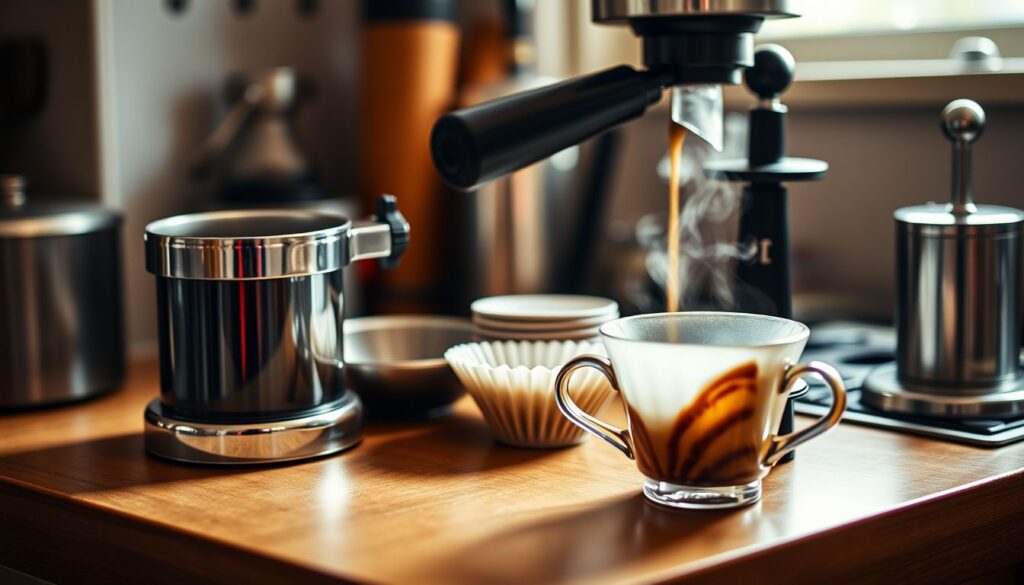
Quick Answer: When comparing puck screen vs paper filter for espresso, puck screens sit on top of the coffee puck and spread incoming water to reduce channeling, while paper filters go at the bottom of the basket to create uniform flow and trap fines. Puck screens work better for medium-dark roasts and reduce machine cleaning, while paper filters excel with light roasts for cleaner, more articulate flavors.
The first sign something’s wrong isn’t taste—it’s sound.
It’s that gentle espresso hiss turning into an anxious gurgle, like your machine is trying to tell you, “Hey bestie… your puck is falling apart.” Then the stream goes from tiger-striped caramel to pale, chaotic spray. Your kitchen smells promising—dark chocolate, toasted sugar—but the cup tastes thin, bitter, and weirdly sour at the same time.
That’s channeling. And yes, it can happen even if you own a shiny machine with more stainless steel than my tiny NYC apartment deserves.
So you buy a puck screen. Or you cut little paper circles like a middle-school art project. Or you do both, because coffee people have the impulse control of a toddler in a sprinkle aisle.
Let’s be real for a second: both tools can reduce channeling. But they don’t do it the same way, and they don’t taste the same in the cup. I’ve tested a lot of these, and honestly, the “best” option depends on your basket, your grinder, and whether you’re willing to clean one more annoying thing before 8 a.m.
First: What Espresso Channeling Prevention Actually Involves
Channeling is when water under pressure finds the path of least resistance through the puck. Instead of evenly extracting the whole bed, you over-extract some spots (hello, harsh bitterness) and under-extract others (hello, sourness and hollow body). You can have a perfect recipe—say, 18 g in, 36 g out (1:2) in 25–30 seconds at 93°C/200°F—and still end up with a shot that tastes like it’s arguing with itself.
Here’s what the marketing copy won’t tell you: “channeling” is often a symptom, not the disease. The disease is usually prep—uneven distribution, clumps, or a puck that gets wrecked by the first blast of water.
This is where the puck screen vs paper filter debate becomes more than academic—it’s about solving different root causes of espresso channeling prevention.
So what do puck screens and paper filters change?
They change how water enters and moves through the puck.
A puck screen (usually 1.7 mm thick stainless mesh) sits on top of the coffee. It spreads the incoming water and reduces the jetting effect from the shower screen. Think “diffuser,” not “magic.”
A paper filter under espresso puck (usually a 58 mm paper circle, like Aeropress-style paper cut to size) is typically placed at the bottom of the puck, inside the basket. It adds a more uniform boundary layer, can reduce fines migration, and sometimes increases flow consistency.
| Feature | Puck Screen | Paper Filter |
|---|---|---|
| Placement | Top of coffee puck | Bottom of basket |
| Cost | $15-30 one-time | ~$0.05 per shot |
| Best for | Medium-dark roasts | Light roasts |
| Maintenance | Daily rinse required | Single use |
| Primary benefit | Cleaner machine | Clearer flavor |
Actionable takeaway you can do today
Before you buy anything, run this quick diagnostic:
- Pull your normal shot at 9 bar (or whatever your machine is set to), then look at the puck
- If the top is cratered or looks like it got hit with a tiny meteor, a puck screen may help
- If the bottom is muddy, sludgy, or your shot blondes early even with good prep, paper may help
- If your puck prep is “tap the portafilter and pray,” buy a WDT tool before either of these
My nonna would roll her eyes at this whole conversation, but she’d still tell you: do the basics first. Just like with drip coffee, proper filter preparation can dramatically impact your final cup quality.
Espresso Puck Screen Benefits: What Actually Improves
The biggest immediate benefit of a puck screen is unsexy: your shower screen stays cleaner.
On machines like the Gaggia Classic Pro or Rancilio Silvia, that’s huge because they can be a little… enthusiastic with water delivery. On something more stable like a La Marzocco Linea Micra or a Breville Dual Boiler, it’s less dramatic, but still noticeable.
When a puck screen works, the shot looks calmer. The stream comes out more centered, with fewer sudden blonding bursts. The aroma tends to be rounder too—think cocoa powder and toasted hazelnut instead of sharp, steamy bitterness.
But let me be blunt: puck screens are not free.
What puck screens can improve
More even wetting on the top of the puck. That can reduce channel initiation.
Slightly more forgiving extractions. On a medium roast like Counter Culture Hologram, I often got a thicker, more “nougat-y” mouthfeel—silky, medium body that coats your tongue instead of disappearing.
Less puck erosion. Especially helpful if you’re running higher flow or doing fast ramps.
What puck screens can mess up
If your headspace is tight (coffee bed too high), a puck screen can cause the puck to press into the shower screen. That mechanical contact can crack the puck and create channeling—the exact problem you’re trying to solve. It’s like buying a standing desk and then installing it under a staircase.
If you dose 18 g in a tight basket and the puck screen leaves an imprint from the shower screen screw, back off. Try 17 g, or use a basket with more headroom (like an IMS 18–20 g).
Actionable puck screen setup (no vibes, just numbers)
- Start with: 18 g in / 36 g out
- Set temperature to 93°C/200°F
- Aim for 28 seconds from pump on
- Check headspace before extraction
- Rinse screen immediately after use
If the shot slows down by more than ~3–5 seconds after adding the puck screen, don’t panic and grind coarser immediately. First, check headspace. Reduce dose by 0.5–1.0 g and re-test.
And please, for the love of my roommate’s patience: rinse the screen right away. Dried coffee oils turn it into a tiny greasy hockey puck.
Paper Filters: The Sneaky Move That Can Make Espresso Taste Clearer
Paper in espresso sounds like something an influencer would “discover” and then sell you a subscription for.
But paper filters—especially bottom paper inside the basket—can genuinely change extraction behavior. The first time I tried it on a light roast washed Ethiopian (think Sey Coffee style: floral, citrus-forward, high acidity), the difference wasn’t subtle.
The cup smelled like bergamot and jasmine instead of wet cardboard. The acidity tasted more like lemon candy than sour grapefruit pith. And the finish? Cleaner, less dusty.
Why paper can reduce channeling
Paper acts like a flow-regulating layer at the bottom of the puck. It can help distribute flow as the coffee exits the puck, and it can trap some fines that would otherwise migrate and clog micro-pathways unevenly.
It’s not “more extraction” automatically. It’s often more uniform extraction, which tastes sweeter and more coherent.
In practical terms: on grinders that produce more fines (or when your burr alignment is… let’s call it “romantically imperfect”), paper can smooth out the chaos.
When paper makes espresso worse
If you love heavy, sludge-adjacent espresso—think a natural Brazil that tastes like peanut butter and dark chocolate—paper can make it feel too “clean.” Less bass, more treble.
On some coffees, you’ll perceive it as less body, less syrup, less of that chewy texture that makes you go, “Oh wow.” You might get more clarity, but the shot can feel thinner.
Also, workflow: paper is fiddly. At 6 a.m., with one eye open, you will drop a wet paper circle on your counter and question your life choices.
Actionable paper filter method (repeatable, not annoying)
- Use 58 mm espresso paper (or cut Aeropress filters if you’re committed to chaos)
- Place paper flat at the bottom of the basket, then dose
- Use your normal recipe: 18 g in, 36 g out, 93°C/200°F
- If the shot runs faster by 2–4 seconds, grind slightly finer (tiny adjustments—on a Niche Zero, think a hair; on a DF64, think a micro-step)
If you want to be extra controlled, hold everything constant and taste for sweetness and finish. The best paper shots have a clean, sweet “snap” at the end—like biting into a ripe peach instead of chewing citrus rind.
Taste and Texture: What You’ll Actually Notice in the Cup
If you’re expecting either tool to turn your espresso into a god shot every time, I have bad news and a subway commute to sell you.
What you’ll notice is more specific—and more useful.
With a puck screen, I usually get
A shot that feels steadier. The stream looks more cohesive. The crema can look slightly more uniform—less patchy, more consistent tiger striping.
On medium roasts, the texture often improves: more caramel, more milk-chocolate body, less sudden bitterness. On something like Onyx Monarch, that can read as richer and rounder, especially in milk.
Actionable: if your espresso tastes good but your machine gets dirty fast (hello, oily dark roasts), a puck screen is worth it for cleanliness alone.
With bottom paper, I usually get
More clarity. Less muddiness. A finish that’s cleaner and more articulate.
On a washed Colombia, you’ll taste the fruit more distinctly—red apple, panela sweetness, maybe a little cocoa nib—rather than “coffee flavored coffee.” The aroma can pop too: bright citrus and honey instead of generic roast.
Actionable: if you’re chasing modern light-roast espresso—florals, stone fruit, sparkling acidity—paper is the more dramatic upgrade.
But does either “reduce channeling” more?
If your channeling is caused by top-of-puck disruption (water jetting, puck erosion, too much turbulence), the puck screen tends to help more.
If your channeling is caused by uneven flow through the puck (fines migration, localized clogging, inconsistent exit flow), paper often wins.
And if your channeling is caused by bad distribution? Neither is your savior. Get a decent WDT tool (I like thin needles, ~0.35 mm), stop doing the “tap-tap-hope” routine, and suddenly your espresso gets less dramatic.
My No-BS Buying Advice (Because You Have Rent to Pay)
Is it good? Yes. Is it worth the premium over the cheaper option? Let me explain.
A puck screen can run you $10–$30. Paper filters are cheap per shot, but you’ll keep buying them. Both are affordable compared to “upgrading” your machine because TikTok told you to.
If you should buy only one, here’s my rule
If you pull mostly medium to dark roasts, drink milk drinks, and hate cleaning: get a puck screen.
If you pull mostly light roasts, drink straight espresso, and chase clarity: get bottom paper filters.
If you’re pulling 2–3 shots a day on something like a Breville Bambino Plus or the Bosch 300 Series, paper is a low-commitment experiment. If you’re dialing in a picky single origin on a Linea Micra with a Eureka Mignon Specialità, paper can feel like unlocking an extra gear.
A simple at-home test that tells you the truth
Pick one coffee and keep it constant. A washed Ethiopia is great because it shows flaws fast.
- Baseline shot (no screen, no paper)
- Puck screen only
- Paper only
Keep the recipe locked: 18 g in, 36 g out, 93°C/200°F, target 28 seconds. Taste in that order, back-to-back.
If you want to get nerdy (I do, obviously), measure TDS with a refractometer and calculate extraction yield. But you don’t need lab gear to notice when one version smells like orange blossom and the other tastes like regret.
Troubleshooting Common Issues
If your puck screen leaves marks
- Reduce dose by 0.5g and retest
- Check basket headroom—switch to a larger capacity basket if needed
- Ensure screen sits flat without pressure contact
If paper makes shots run too fast
- Grind slightly finer (micro-adjustments only)
- Check paper placement—ensure it’s completely flat
- Try a different paper thickness or brand
Frequently Asked Questions
Can you use both a puck screen and paper filter together?
Yes, but it’s overkill for most setups. The combined resistance can slow extraction significantly, requiring much coarser grinds. Start with one, master it, then experiment if you’re still chasing improvements.
How long do puck screens last?
With proper daily cleaning, a quality stainless steel puck screen can last years. The main wear points are the mesh holes stretching over time and potential warping from thermal cycling.
Do paper filters affect espresso crema?
Paper filters typically reduce crema volume slightly but can improve crema stability and appearance. The trade-off is usually worth it for the flavor clarity gains, especially with light roasts.
Conclusion: Pick the Tool That Fixes Your Problem, Not Someone Else’s Content
Coffee gear culture loves a silver bullet. It’s the same vibe as consumer tech launches: lots of hype, a few real improvements, and a weird number of grown adults arguing about microns.
When evaluating puck screen vs paper filter options, both can absolutely reduce channeling—but only if you’re solving the right failure point in your puck. If you buy a puck screen when your distribution is sloppy, you’re basically putting a Band-Aid on a spreadsheet error.
So try one. Taste it like you mean it. Then decide if the difference is worth the added fuss in your morning routine.
Before investing in specialty equipment, make sure you have the fundamentals of filtration dialed in first.
And if none of it works? My nonna’s dented Moka pot is sitting right here on my counter, silently judging all of us. Honestly, she might be right.
Leave a Comment