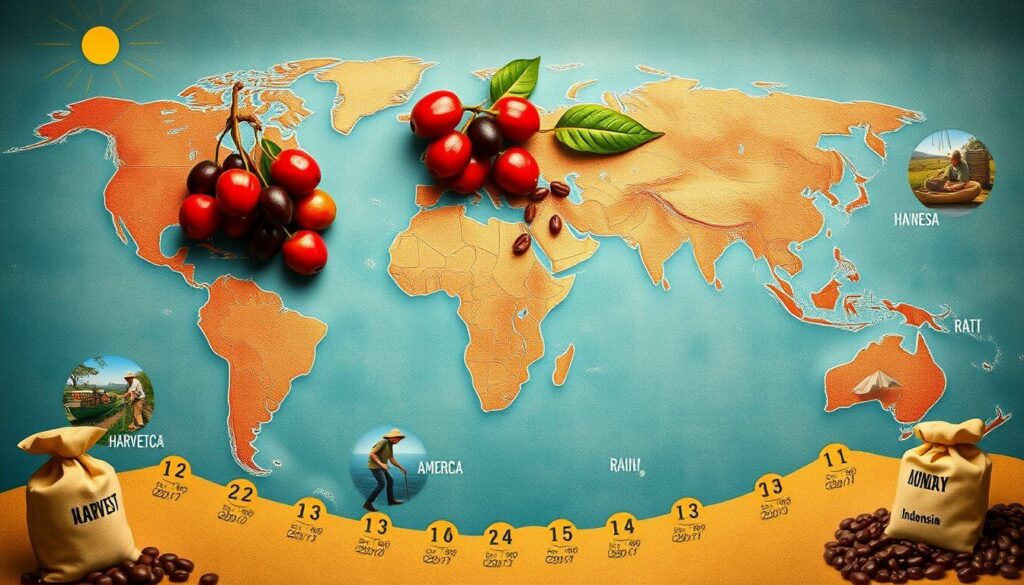
Quick Answer: Coffee harvest seasons vary by hemisphere and region. Northern hemisphere countries (Central America, Ethiopia, Mexico) harvest October-March, while southern hemisphere origins (Brazil, Peru, Rwanda) harvest April-September. Equatorial regions like Colombia and Kenya have two harvest seasons annually. Fresh coffee maintains peak quality for 6-12 months after harvest, making seasonal coffee beans shopping crucial for optimal flavor.
Last week, I stood in Don Carlos’s coffee fields outside Huehuetenango, Guatemala, watching pickers carefully select only the ripest cherries from branches heavy with fruit. “January is our time,” he told me, gesturing at the mountainside dotted with workers carrying their harvest baskets. “But my friend in Colombia? His best beans come in October.”
This simple observation captures something crucial that many coffee drinkers never consider: coffee doesn’t grow year-round in any single location. Like wine grapes or seasonal produce, coffee cherries ripen according to precise natural rhythms dictated by rainfall, temperature, and geography. Understanding these patterns isn’t just academic curiosity—it’s the key to drinking fresher, more vibrant coffee throughout the year.
Understanding Coffee Harvest Seasons: The Global Calendar
Coffee harvest seasons follow a predictable dance across the globe, with each region’s peak season determined by its position relative to the equator and local weather patterns. Countries north of the equator typically harvest from October through March, while southern hemisphere nations pick from April through September.
But here’s where it gets interesting: some countries near the equator, like Colombia and Kenya, have two harvest seasons annually.

Northern Hemisphere Harvests (October – March)
Walking through Central American farms in December feels electric. In Guatemala, El Salvador, and Honduras, harvest runs from November through March, with peak quality often arriving in January and February. Mexico starts slightly earlier, with picking beginning in November. These beans typically reach roasters’ warehouses by March or April, making spring the ideal time to enjoy fresh Central American coffees.
Ethiopia, the birthplace of coffee, operates on a similar schedule. Their main harvest runs from October through January, though regional variations exist. Yirgacheffe’s famous washed coffees arrive at port around February, while natural processed beans from Guji might not ship until April. I’ve learned to mark my calendar for May—that’s when Ethiopian coffees taste their absolute best, having rested just long enough after processing.
Don Carlos’s careful cherry selection reflects traditional coffee harvesting methods passed down through generations, where timing and technique determine final cup quality.
Practical tip: Buy Central American and Ethiopian coffees between March and July for optimal freshness. After August, these beans start showing their age through faded acidity and muted flavors.
Southern Hemisphere Harvests (April – September)
Brazil, producing nearly 40% of the world’s coffee, drives the southern hemisphere schedule. According to the International Coffee Organization’s 2025 report, Brazil produced 69.9 million 60kg bags, representing 39% of global production. This massive volume makes Brazil’s harvest timing crucial for global coffee prices and availability.
Their harvest runs from May through September, with mechanized picking on large fazendas creating an efficient but intensive season. I visited during harvest last year and watched machines strip entire tree sections in minutes—a stark contrast to the hand-picking I’d witnessed in Guatemala.

Peru and Ecuador follow similar patterns, harvesting from April through September. These origins often get overlooked, but their seasonal timing makes them perfect alternatives when northern hemisphere coffees grow stale. Indonesian regions like Sumatra and Java harvest year-round due to their equatorial position, but their main crop arrives April through June.
Practical tip: Stock up on Brazilian and Peruvian coffees in September through December. They’ll be at peak freshness while you wait for new Central American harvests.
Reading Freshness: What “New Crop” Really Means
The term “new crop” gets thrown around liberally in coffee marketing, but understanding what it actually means can transform your coffee buying decisions. New crop refers to the most recent harvest from a particular origin, but here’s the counterintuitive truth: the newest crop isn’t always the best choice.
Green coffee needs time to rest after processing, typically 30-60 days, allowing moisture levels to stabilize and flavors to settle.
I learned this the hard way when I rushed to roast coffee straight off the boat from Honduras—the resulting brew tasted grassy and unstable. Now I wait at least a month after arrival before getting excited about new harvests.
The Freshness Window
Green coffee maintains peak quality for 6-12 months after harvest when stored properly. Research from UC Davis’s Coffee Center found that green coffee loses approximately 5-10% of its volatile aromatic compounds every three months after harvest, with accelerated decline after 12 months.
After that window, you’ll notice what we call “past crop” characteristics:
- Woody or cardboard-like flavors
- Faded or muted acidity
- General flatness and lack of complexity
- Loss of origin-specific characteristics
Green coffee maintains peak quality for 6-12 months after harvest when stored properly. Once roasted, proper storage becomes even more critical—understanding how coffee bag valves work helps preserve those seasonal characteristics you’ve worked so hard to time correctly.

Here’s a surprising fact: some high-end roasters intentionally age certain coffees. But for most origins, the relationship between roast date and peak flavor follows a predictable curve that starts with the harvest date—fresh green coffee produces more vibrant roasted coffee. Indian Monsooned Malabar and aged Sumatras develop unique flavors through controlled aging, but these are exceptions. For most coffees, fresher means better.
Practical tip: Check harvest dates, not just roast dates. If you’re buying Colombian coffee in January, it should be from the October harvest (Mitaca crop), not the previous year’s main crop from May.
Building Your Seasonal Rotation Based on Coffee Harvest Seasons
Creating a year-round rotation based on coffee harvest seasons requires thinking like a roaster. Understanding when each origin peaks helps you map out your preferred flavor profiles across the calendar. Love bright, floral coffees? Plan for Ethiopians in spring, Kenyans in winter, and Colombians in fall.
The key to enjoying fresh coffee year round is following this migration pattern across origins.
Sample Seasonal Calendar
January-March: Focus on fresh Central Americans arriving at port. This is prime time for Guatemala Huehuetenango, El Salvador Pacamara, and Costa Rica Tarrazú. Brewing these fresh seasonal beans properly matters—a reliable drip coffee maker like the Mr. Coffee 12-cup helps you taste the seasonal differences clearly without over-extracting delicate harvest notes. These coffees showcase chocolate and caramel notes with bright acidity.
April-June: Transition to fresh Ethiopians and last year’s excellent Colombians. The contrast between Ethiopian florals and Colombian balance provides variety. Start watching for new Brazilians. If you’re experimenting with multiple origins simultaneously, a versatile single-serve coffee maker lets you brew small batches of different seasonal beans without committing to full pots.
July-September: Peak season for Brazilians, Peruvians, and Rwandans. Brazil’s nutty, chocolatey profiles work perfectly for espresso, while Rwanda offers surprising complexity for filter brewing.
October-December: Fresh Kenyans arrive, along with Colombia’s main harvest. Kenya’s black currant intensity and Colombia’s versatility close out the year strong.
I adjust this schedule based on actual arrival dates, which vary yearly depending on weather, processing delays, and shipping logistics. For ultimate control over seasonal freshness, some enthusiasts buy green coffee beans and roast at home, allowing them to purchase seasonal beans in bulk and roast as needed. Following a few trusted importers on social media helps track when specific lots arrive.
| Month Range | Best Origins to Buy | Flavor Profiles | Why It’s Peak |
|---|---|---|---|
| Jan-Mar | Guatemala, El Salvador, Costa Rica, Mexico | Chocolate, caramel, bright acidity | Fresh from November-March harvest |
| Apr-Jun | Ethiopia, Colombia (Mitaca crop), Kenya (finishing) | Floral, fruity, complex | Ethiopian new crop arrives |
| Jul-Sep | Brazil, Peru, Rwanda, Indonesia | Nutty, chocolatey, full-bodied | Southern hemisphere peak freshness |
| Oct-Dec | Kenya, Colombia (main crop), India | Black currant, balanced, spicy | Main harvest arriving fresh |
The Impact of Processing on Seasonal Timing
Processing methods significantly affect when coffees reach market. Natural processed coffees, which dry with the cherry intact, take 3-4 weeks longer than washed coffees. This explains why Ethiopian naturals often arrive months after their washed counterparts from the same harvest.
During a visit to a Colombian beneficio (wet mill), I watched the producer manage three different processing methods simultaneously. His washed coffees shipped within six weeks of harvest, honey processed beans took two months, and naturals weren’t ready for export until month three. Each method created distinct flavor profiles from the same trees, but timing varied dramatically.
Anaerobic and other experimental processes add even more complexity. These methods can extend processing time by weeks, pushing availability later into the season. However, The Intersection of Coffee and Fermentation: Exploring Novel Flavor Techniques for Home Brewers shows how these techniques create unique flavors worth waiting for.
Practical tip: If you love natural processed coffees, expect them 1-2 months after washed coffees from the same origin. Plan your purchasing accordingly.
Working with Seasonal Limitations
Seasonal availability creates both challenges and opportunities. Your favorite Guatemalan might only taste optimal for four months annually, but this limitation pushes you to explore new origins. I’ve discovered incredible coffees from Myanmar, Thailand, and China simply because I needed alternatives during traditional off-seasons.
Roasters manage seasonality through strategic purchasing and storage. Many buy enough of their signature coffees to last until the next harvest, storing them in climate-controlled warehouses.
For home enthusiasts, this might mean buying a few extra bags of that exceptional Kenyan in February to last through spring.
Understanding how The Influence of Local Climate Patterns on Coffee Bean Development and How Home Brewers Can Adapt Their Techniques helps appreciate why certain regions produce coffee when they do. Climate change increasingly disrupts traditional harvest patterns, making flexibility essential.
Supporting Farmers Through Seasonal Purchasing
Buying seasonally appropriate coffees supports farmers more than you might realize. When demand aligns with harvest schedules, farmers receive better prices for fresh crops rather than storing coffee and risking quality degradation. This direct connection between seasonal purchasing and farmer welfare became clear during my visits to origin.
In Rwanda, I met a cooperative leader who explained how seasonal buying patterns affect their community. “When buyers want our coffee fresh in October, we can sell immediately after processing. This cash flow lets us pay pickers promptly and invest in next year’s crop.” Contrast this with buyers demanding year-old coffee at discounted prices, forcing farmers to accept losses on degraded inventory.
Coffee buyer and author James Hoffmann notes in his 2024 book that seasonal purchasing represents “the single most impactful decision a consumer can make for both quality and ethics.” When roasters commit to seasonal contracts, farmers can invest in better processing infrastructure, creating a positive cycle of quality improvement.
The Evolution of Coffee Farm Sustainability Practices and Their Influence on Your Brew’s Flavor explores how seasonal purchasing patterns support sustainable farming practices.
Practical tip: Support farmers by buying their coffees during peak season. Your purchase timing directly impacts their economic stability.
FAQ
How can I tell if coffee is from the current harvest?
Look for harvest dates on packaging or ask your roaster directly. Reputable roasters proudly share this information. If buying green coffee, check the ICO (International Coffee Organization) mark on bags, which includes harvest year.
Do all coffees from the same country harvest simultaneously?
No, regional variations exist within countries. Colombia’s multiple mountain ranges create distinct harvest zones. The main crop (principal) runs April-June, while the fly crop (mitaca) happens October-December. Different regions peak at different times within these windows.
Should I avoid past crop coffees entirely?
Not necessarily. Well-stored past crop can still taste good, especially for espresso blends where some age adds body. However, for single-origin filter coffee highlighting terroir, current crop usually tastes better. Price should reflect crop year—past crop should cost less.
How do roasters maintain consistent blends with seasonal variation?
Skilled roasters adjust blend components seasonally while maintaining flavor profiles. They might use fresh Guatemalan in spring, switching to fresh Colombian in fall, keeping the chocolate-caramel profile consistent. This requires deep understanding of how different origins express similar flavors.
Can I freeze green coffee to extend freshness?
Freezing green coffee is controversial and generally unnecessary for home users. Proper storage at stable temperatures (60-70°F) with 60% humidity maintains quality for months. Only consider freezing for long-term storage of exceptional lots, using vacuum-sealed bags to prevent moisture damage.
How does climate change affect coffee harvest seasons?
Climate change increasingly disrupts traditional harvest patterns. The 2025 NOAA Climate Report noted that coffee-growing regions experienced 23% more unpredictable rainfall patterns compared to 2015. This means harvest windows are becoming less predictable—in 2025, Guatemala’s harvest started three weeks late due to extended rains. For consumers, this reinforces the importance of following actual crop arrivals rather than relying on historical calendars alone.
Conclusion
Following coffee harvest seasons transformed my appreciation for this global crop. Each origin’s harvest window tells a story of geography, climate, and agricultural tradition. By aligning our purchasing with these natural cycles, we drink better coffee while supporting farming communities more effectively.
The next time you buy coffee, consider its journey from harvest to cup. Is it from the current crop? Does its harvest season align with your purchase date? These questions lead to fresher, more vibrant coffee experiences—and they’ll change how you shop. This month, check your local roaster’s offerings and ask: “Which of these is from the current harvest?” Start with just one seasonal coffee, note its freshness, and you’ll never go back to drinking coffee the old way.
Leave a Comment