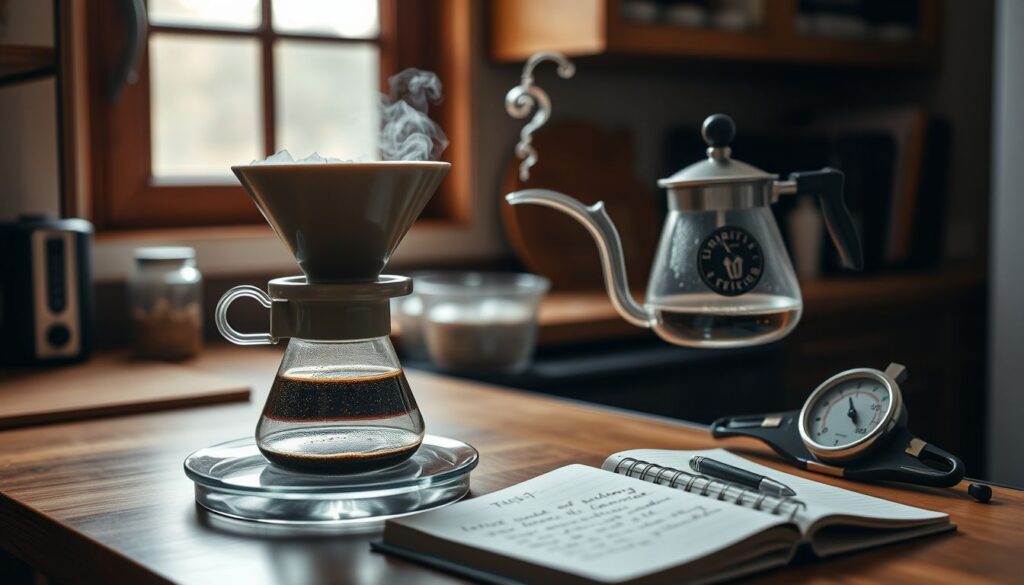
How to Fix Bitter Pour-Over: Grind, Water, and Agitation (2026)
The first sip tells you before your brain catches up. The aroma is all jasmine and warm citrus, steam curling up from the cup… and then the taste lands like chewing on lemon peel and aspirin.

I’ve been there—standing over a [Hario V60](https://www.amazon.com/dp/B001RBTSMM?tag=coffeelogik-20&linkCode=osi&th=1&psc=1) with a kettle still whispering, wondering how a coffee from Sey or Tim Wendelboe can smell like peach tea but finish like walnut hulls. Here’s the surprising fact I wish someone had told me earlier: most bitter pour-overs aren’t because you “brewed it wrong.” They’re because one variable pushed extraction over the edge—often fines + hot water + too much agitation—and your palate is simply reporting the data.
As a former lab scientist, I can’t not treat this like troubleshooting an instrument. We’ll run a controlled experiment: identify what kind of bitterness you’re tasting, then adjust grind, water, and agitation with specific targets. You’ll get actionable steps in each section, plus real-number parameters (ratios, temperatures, times) you can use today.
1) Bitter, Astringent, or Roast-Bitter? Diagnose Before You Fix
Not all bitterness is the same, and changing the wrong variable can make you chase your tail.
What bitterness are you actually tasting?
Over-extraction bitterness tastes sharp and lingering—think grapefruit pith, tonic water, or the white part of orange peel. It often comes with a dry, puckering finish (astringency) that makes your tongue feel sandpapery.
Roast bitterness tastes darker and heavier—cocoa husk, burnt toast, smoky ash. You’ll smell it in the dry grounds too. A darker roast from, say, a supermarket “French Roast” can be bitter even at low extraction.
Channeling bitterness is the sneaky one: the cup starts thin or sour, then ends harsh. That’s uneven extraction—some grounds under-extracting (sour), others over-extracting (bitter).
Quick diagnostic you can do right now
Brew your usual recipe, then do this:
- Smell the wet bed after the drawdown. If it smells pleasantly sweet (caramel, cocoa, florals) but the cup is harsh, you likely over-extracted via fines/agitation.
- Taste at different temperatures. If it’s harsh when hot but becomes sweet as it cools, you’re probably close—just slightly over. If it stays bitter even cool, roast bitterness or severe over-extraction is more likely.
Actionable takeaway
For your next brew, write down three numbers and one sensory note:
- Dose (grams of coffee)
- Total water (grams)
- Total brew time (minutes:seconds)
- One phrase describing the finish (dry? smoky? pithy?)
This tiny log turns “my coffee is bitter” into a solvable pattern.
2) Grind: The Fastest Lever (and the #1 Source of Hidden Bitterness)
In pour-over, bitterness often rides in on fines—the powdery particles that extract extremely fast. Too many fines, and even a “normal” brew time can taste harsh.
Start with a concrete target
For a V60 (02 size), a solid baseline is:
- 15 g coffee to 250 g water (1:16.7)
- 93–95°C water for light to medium roasts
- Total time: 2:45–3:30 (depending on grinder, filter, and pouring style)
If you’re consistently getting bitterness with a drawdown over 3:45, your V60 grind size is probably too fine or your fines load is high.

Grinder reality check (yes, it matters)
I’ve brewed the same washed Ethiopian on a Baratza Encore and a Comandante C40, same ratio, same kettle (Fellow Stagg EKG), and the difference was not subtle. The Encore produced more fines, the drawdown slowed, and the cup leaned papery-bitter and dry. The C40 gave me more clarity—bergamot, honey, a silky body instead of a gritty finish.
You don’t need a new grinder to improve, but you do need to adapt your method to what your grinder produces.
Two practical grind adjustments that actually work
1) Go coarser in small, repeatable steps.
- Hand grinder: adjust 2–4 clicks coarser (Comandante-style).
- Electric stepped grinder: move 1–2 steps coarser (Encore-style).
Then keep everything else the same and re-taste.
2) Reduce fines impact without buying gear.
If your grinder produces lots of fines, avoid aggressive swirling (we’ll cover this) and consider a faster-flow filter like Cafec Abaca for V60. It can shave bitterness by preventing a stalled, over-extracted tail end.
Actionable takeaway
If your brew time is over 3:45 and the finish is dry and pithy, change only one variable next time: grind coarser until you land in the 2:45–3:30 window. Keep dose and ratio constant so your taste buds can learn the difference.
3) Water: Temperature and Chemistry Can Turn Sweetness Into Bite
In the lab, we used to say, “Your instrument is only as good as your reagents.” In coffee, water is the reagent.
Temperature: don’t hide behind “hot”
Water temperature changes extraction speed—especially of bitter compounds.
Try these starting points:
- Light roast (washed Ethiopia, Kenya, many Nordic-style roasts): 94–96°C
- Medium roast (most “specialty comfort” profiles): 92–94°C
- Dark roast (chocolate-forward, lower-acidity coffees): 88–92°C
If you’re using a kettle like the Fellow Stagg EKG or Bonavita 1.0L variable-temp, set it intentionally. A 2°C shift can be the difference between apricot jam and bitter citrus rind.
Chemistry: your tap water might be the villain
If your coffee tastes harsh no matter what you do, your water’s alkalinity and mineral balance might be stripping sweetness.
A practical, brew-friendly target (aligned with SCA-style thinking) is:
- Total hardness: ~50–100 ppm as CaCO3
- Alkalinity: ~30–50 ppm as CaCO3
- TDS: ~100–150 ppm
Too high alkalinity can flatten acidity and push the cup toward dull bitterness. Too low mineral content can make extraction uneven—thin early, harsh late.
Real-world fixes that don’t require a chemistry degree
- If your tap water is inconsistent, use distilled water + Third Wave Water (their Light Roast profile is a great starting point for brighter coffees).
- If you prefer filtration, a BWT Pitcher can add magnesium (often perceived as sweeter extraction) while reducing harshness.
Actionable takeaway
If your coffee is bitter and also tastes dull (not just strong), do one controlled test:
Brew the same recipe twice—once with your tap water, once with distilled + Third Wave Water—at 94°C. If the bitterness drops and sweetness rises (think honey, stone fruit, cocoa), you’ve found a water problem, not a technique problem.
4) Agitation: The Bitter Switch You Flip Without Realizing
Pour over agitation is turbulence—how much you physically disturb the coffee bed. It increases extraction and can also move fines into the filter, slowing flow and over-extracting the end of the brew.
I love a dramatic swirl as much as anyone. But if your cup tastes like over-steeped black tea with a dry finish, your agitation is probably too high.
Use a pour plan that limits chaos
Here’s a V60 recipe I use when I want sweetness without bite:
- Dose: 20 g
- Water: 320 g (ratio 1:16)
- Temp: 94°C for light roast, 92°C for medium
- Bloom: 60 g for 40 seconds (3:1 bloom)
- Pour 1: gentle spiral to 200 g by 1:15
- Pour 2: gentle spiral to 320 g by 2:00
- Target finish: drawdown around 3:00–3:30
The key word is gentle. You’re not pressure-washing the bed. You’re placing water.
Stirring vs swirling (and why your swirl might be overdoing it)
- Stirring the bloom (2–3 gentle stirs with a spoon or a WDT tool) can help wet all grounds without over-agitating later. Learn more about coffee bloom explained and proper timing techniques.
- Swirling hard at the end can pack fines into the filter and create a slow, bitter tail.
If you like swirling, keep it small: one light swirl right after the final pour to level the bed, not a tornado.
Equipment that can help
A Melodrip (or even pouring onto the back of a spoon) reduces turbulence dramatically. On a high-fines grinder, it can turn a harsh cup into something that smells like orange blossom and tastes like ripe peach with a clean, tea-like body.
Actionable takeaway
If your bitterness spikes at the end of the sip, keep your grind the same and change only agitation:
- Do no end swirl for one brew.
- Use a single gentle swirl for the next.
Taste side-by-side. The difference can be shocking.
5) Flow Rate, Filters, and Brew Time: Stop Over-Extracting the Last 20%
A lot of bitterness lives in the final stretch of the drawdown. That’s where water is hottest, the bed is most compacted, and the remaining solubles skew toward the harsher end.
Know your dripper’s personality
- Hario V60: high clarity, very responsive, also unforgiving if your grind/agitation pushes fines into the filter.
- Kalita Wave 185: more even flow, often more forgiving, tends to produce a rounder, sweeter cup with less “edge.”
If you’re consistently bitter on a V60, trying the same coffee on a Kalita Wave-style dripper can be a revealing experiment.
Filters are not neutral
I’ve tasted bitterness that was basically paper + over-extraction. Filter choice changes flow and mouthfeel.
- Cafec Abaca (V60): fast flow, bright clarity, helps reduce stalled drawdowns.
- Hario Tabbed Filters: often slower; can be great, but more prone to long drawdowns if your grinder produces fines.
Always rinse with hot water. Beyond removing paper taste, it preheats the brewer so your slurry doesn’t drop temperature mid-brew (a sneaky way to create uneven extraction).
A simple timing rule that prevents bitter tails
For most 250–350 g pour-overs, if you’re consistently beyond 4:00, your last phase is likely over-extracting.
Fix it by choosing one lever:
- Grind a touch coarser (best first move)
- Reduce agitation
- Switch to a faster-flow filter
- Use a slightly lower temp (drop 2°C)
Actionable takeaway
Pick a target time and enforce it like a scientist:
For 15 g / 250 g on V60, aim for 2:45–3:30. If you hit 4:15, don’t accept it. Change one variable next brew until your time lands in range, then taste again.
Conclusion: Treat Bitterness Like Data, Not a Personal Failure
When a pour-over turns bitter, it’s tempting to blame your palate or your skills. Don’t. Bitterness is your coffee giving you a readout: too fine, too hot, too agitated, too slow—or occasionally, just too dark a roast for the flavor you want.
Make one change at a time. Write down your numbers. Then listen to the cup as it cools, when sweetness shows itself: the nectarine note that was hiding, the cocoa turning milk-chocolate smooth, the finish shifting from dry to clean.
Tonight, brew one coffee you know well—maybe a washed Ethiopia from Onyx or Counter Culture—and run a single experiment: reduce agitation or drop temperature from 95°C to 93°C. If the bitterness lifts and the cup starts tasting like fruit and florals instead of pith and ash, you didn’t just fix bitter pour-over brewing.
You trained your senses to steer.

Leave a Comment