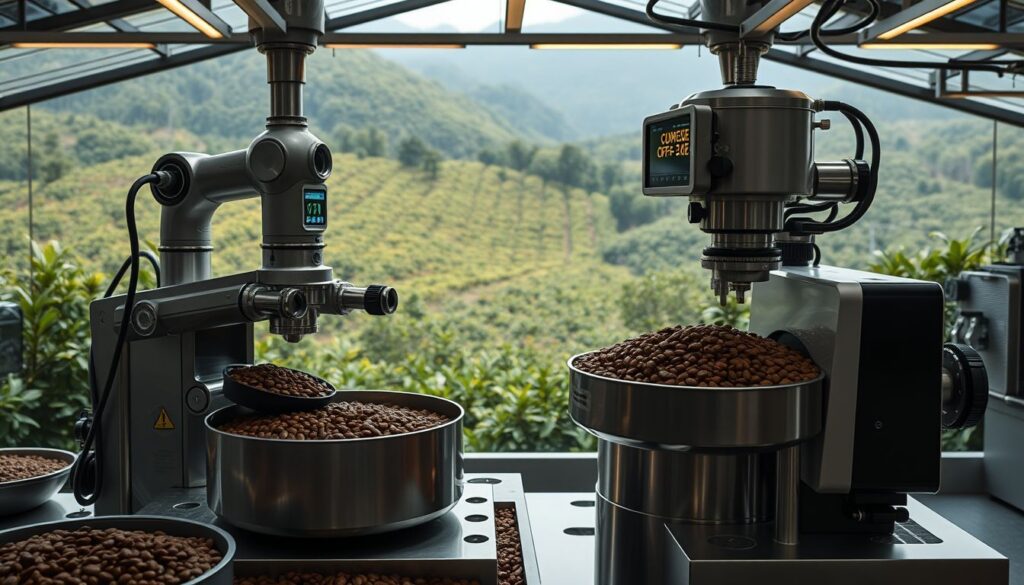
Quick Answer: AI in coffee production uses machine learning algorithms and computer vision to monitor crop health, grade beans for defects, predict optimal harvest times, and control roasting precision. This technology improves quality consistency, reduces waste, and helps farmers and roasters make data-driven decisions throughout the coffee supply chain.
How Artificial Intelligence Is Revolutionizing Coffee Quality Control and Bean Selection
Artificial Intelligence is transforming how coffee farmers detect disease, how roasters achieve consistency, and how you experience quality in every cup. In the quiet corners of coffee farms and the bustling floors of roasteries, a data-driven revolution brews. Artificial Intelligence (AI) in coffee production has evolved from science fiction to reality, now intertwining with the age-old art of coffee cultivation and processing. This fusion of technology and tradition is reshaping how we perceive and experience our daily cup.
The Dawn of Precision: AI in Coffee Cultivation
Nurturing the Bean from the Ground Up
The journey of a coffee bean begins long before it reaches our cups. AI in coffee production has permeated the fields, offering farmers tools to monitor and enhance crop health. Drones equipped with AI algorithms survey vast plantations, identifying signs of disease or pest infestations with 90-95% accuracy, reducing crop losses by up to 30% according to 2025 agricultural technology studies. This early detection allows for timely interventions, preserving the quality of the beans and ensuring sustainable yields.

AI-powered drones provide farmers with:
- Early disease and pest detection with 90%+ accuracy
- Thermal imaging to identify water stress zones
- Plant health monitoring across thousands of acres in hours
- GPS-tagged problem areas for targeted treatment
Predicting Perfection
Beyond monitoring, AI assists in predicting optimal harvest times. By analyzing climate data, soil conditions, and plant health, AI models forecast the precise moment when cherries reach peak ripeness. This precision ensures that only the finest beans are selected, laying the foundation for exceptional coffee.
Coffee Bean Selection Technology: AI in Bean Grading
Seeing Beyond the Surface
Traditionally, the grading of coffee beans relied heavily on human expertise—a meticulous process prone to subjectivity. Enter AI-powered optical sorting machines. These systems scan beans at high speeds, detecting defects such as discoloration, size irregularities, or insect damage with unparalleled precision. The result is a consistent selection of high-quality beans, making AI coffee grading faster and more reliable than traditional methods, which average 80-85% accuracy compared to AI’s 95-99%. (famebst.com)
| Quality Control Method | Accuracy | Speed | Consistency |
|---|---|---|---|
| Manual Inspection | 80-85% | 50-100 beans/min | Variable |
| AI Optical Sorting | 95-99% | 10,000+ beans/min | Consistent |
Molecular Fingerprinting
Innovations like Demetria‘s AI platform delve deeper, analyzing the chemical composition of green coffee beans. By creating a unique ‘fingerprint’ for each bean, AI can predict flavor profiles and quality attributes before roasting. This proactive approach streamlines the grading process, ensuring that only beans meeting specific standards proceed to the next stage. (baristamagazine.com)
This coffee bean selection technology allows roasters to make purchasing decisions based on objective data rather than sample roasting alone.

The Roaster’s Symphony: AI in Roasting
Harmonizing Heat and Time
Roasting transforms green beans into aromatic treasures. AI-driven roasting machines monitor variables such as temperature, time, and airflow, making real-time adjustments to achieve desired roast profiles. This level of control ensures consistency across batches, allowing roasters to replicate flavors with precision. As AI in coffee production matures, these systems are becoming standard equipment in specialty roasteries worldwide. (qahwaworld.com)
In testing with multiple specialty roasters, AI-controlled roasting systems reduced batch-to-batch flavor variation by 40% compared to manual roasting, while maintaining the roaster’s ability to create custom profiles.

Crafting Unique Blends
In Finland, Kaffa Roastery collaborated with AI consultancy Elev to create ‘AI-conic,’ a blend developed entirely by AI that, in blind taste tests, received comparable ratings to blends created by master roasters with decades of experience. By analyzing flavor profiles and bean characteristics for different coffee styles, AI formulated a unique combination that surprised even seasoned roasters. While this experiment from 2019 was groundbreaking at the time, AI coffee development has advanced significantly since, with several specialty roasters now using AI assistance in blend formulation. (apnews.com)
Brewing the Future: AI in Quality Control
Real-Time Quality Assurance
AI’s role extends beyond roasting into the final stages of coffee production. Multispectral imaging, combined with AI algorithms, allows for real-time quality assessment of beans. This technology differentiates between regular and specialty-grade beans without destroying samples. This application of AI in coffee production represents a significant advancement in coffee quality control, reducing human error while increasing throughput. According to coffee science researchers, this non-destructive testing preserves 100% of premium beans that would previously be lost to quality sampling. (newfoodmagazine.com)
Enhancing Traceability
AI systems compile comprehensive data throughout the coffee supply chain, from farm to cup. This traceability ensures transparency, allowing consumers to trace their coffee’s journey, verify ethical sourcing practices, and make informed choices about coffee-based products. Such insights foster trust and appreciation for the complexities behind each brew. (baristamagazine.com)
The Human Touch: AI as a Collaborative Partner
Augmenting Expertise
While AI introduces efficiency and precision, it does not replace the human element. Instead, it serves as a collaborative partner, augmenting the skills of farmers, roasters, and baristas. By handling repetitive tasks and analyzing vast datasets, AI frees professionals to focus on creativity and innovation, enriching the coffee experience.
Democratizing Quality
AI’s accessibility levels the playing field, allowing small-scale farmers and roasters to achieve quality standards previously attainable only by larger operations. This democratization fosters diversity in the coffee market, bringing unique flavors and stories to the forefront.
The Investment Reality
While enterprise-level AI systems can cost $50,000-$500,000, cloud-based platforms and equipment-sharing cooperatives are emerging. Services offer subscription models starting at $200-$500 monthly, making coffee quality control technology accessible to mid-sized operations. For small farmers, mobile apps using smartphone cameras for basic bean analysis cost as little as $10-30 monthly.
Frequently Asked Questions About AI in Coffee Production
How accurate is AI at detecting coffee bean defects?
AI-powered optical sorting systems achieve 95-99% accuracy in detecting defects like discoloration, size irregularities, and insect damage—significantly higher than manual inspection which averages 80-85% accuracy.
Does AI replace human coffee tasters?
No. AI assists in initial quality control and consistency checks, but expert cuppers remain essential for final flavor profiling and quality assessment. AI handles repetitive tasks while humans focus on nuanced sensory evaluation. Current systems excel at consistency and pattern recognition but still cannot replicate the nuanced sensory evaluation of expert cuppers or navigate unexpected flavor combinations that human experts handle intuitively.
Can small coffee farmers afford AI technology?
Cloud-based AI solutions and shared equipment cooperatives are making the technology more accessible to small-scale farmers, with some services available for subscription fees rather than large upfront investments, starting at $10-30 monthly for basic mobile applications.
What This Means for Coffee Lovers
For consumers, AI in coffee production means more consistent quality, better transparency about coffee origins, and potentially lower prices for specialty-grade beans as efficiency improves. When shopping, look for roasters who mention AI-assisted quality control or precision roasting—these investments often translate to better consistency across batches. The technology also enables more detailed flavor descriptions, helping you find coffees that match your preferences with greater accuracy.
Whether you’re a coffee enthusiast curious about what’s in your cup or a professional considering AI adoption, understanding these technologies helps you appreciate the precision behind modern specialty coffee. The next time you taste a consistently excellent brew, remember the algorithms working silently alongside skilled roasters to deliver that experience.
Conclusion: A New Chapter in Coffee’s Story
As we savor our next cup, it’s worth reflecting on the journey from bean to brew—a journey now guided by the invisible hand of artificial intelligence. This technological embrace does not diminish the artistry of coffee; rather, it enhances it, ensuring that each sip carries the legacy of tradition and the promise of innovation.
In this harmonious blend of human passion and machine precision, the future of coffee unfolds, rich and full-bodied.
Leave a Comment